
The Invite-Only School Admissions Test You Don’t Know About
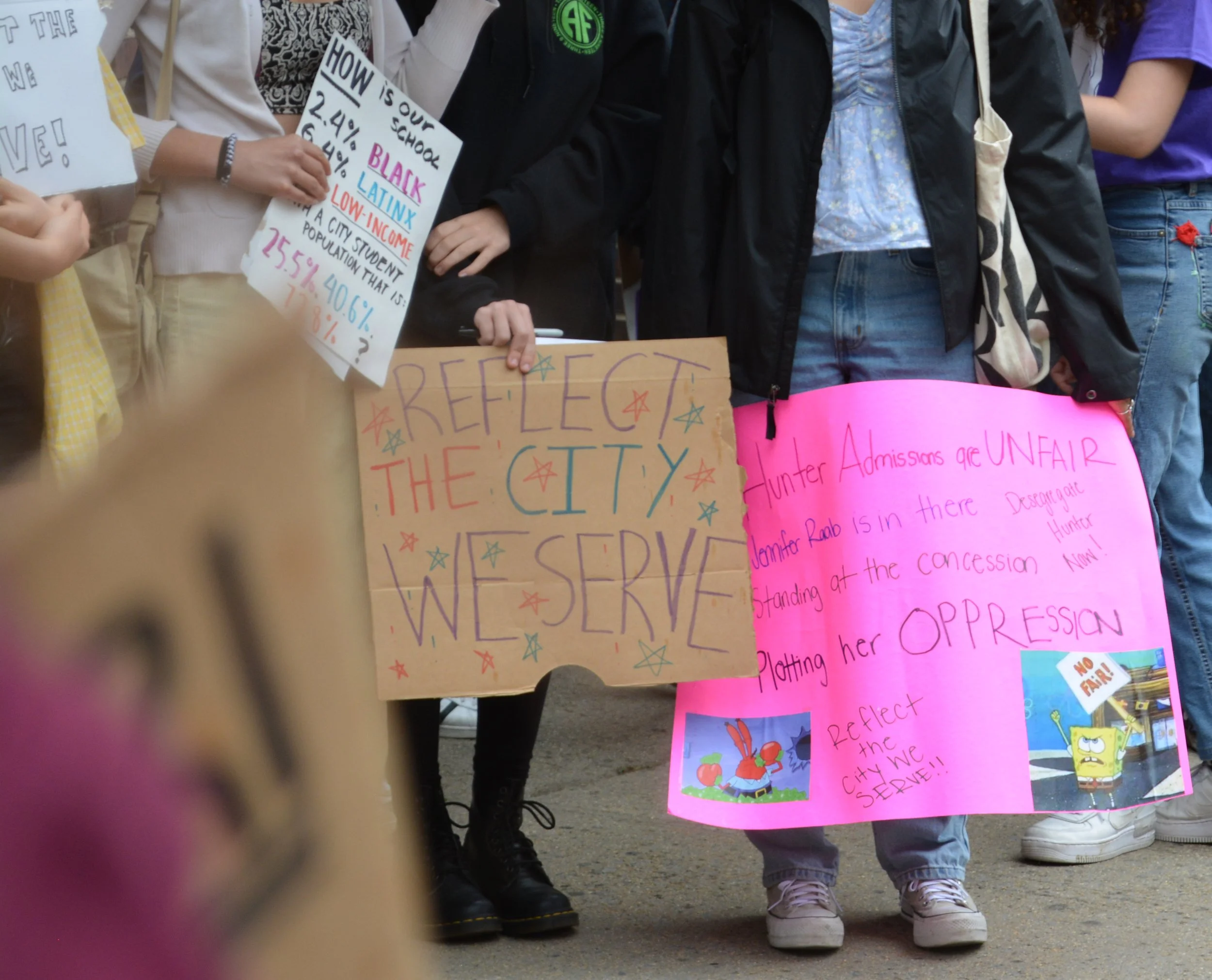
A student group at Hunter College High School is advocating for a more inclusive admissions process at one of New York City’s most selective public schools. Photo courtesy of HCHS4Equity
With an acceptance rate below 10%, Hunter College High School is one of the most competitive public high schools in New York City. It’s also one of the least diverse.
Hunter’s 15.3% student poverty rate was the lowest of any public high school in the city, according to public data from the 2024-25 school year. By comparison, Bronx Science and Stuyvesant, two of the city’s specialized high schools, each had about 50% of students from low-income households.
The lack of socioeconomic as well as racial diversity at Hunter — which is run by CUNY’s Hunter College — doesn’t get as much attention as the demographics at Stuyvesant, Bronx Science, and other specialized high schools in the five boroughs. Like those coveted institutions, Hunter also bases admissions on a test. Except to even qualify for Hunter’s test, you have to be invited, based on state test scores.
Now, with Mayor Zohran Mamdani and his administration backing efforts to bolster integration in public schools, some Hunter students are fighting for change from the inside.
Producers Roberto Bailey, a senior at Hunter, and Zoe George, a senior at Bard High School Early College Manhattan, know the landscape of competitive high school admissions well: They’ve experienced it.
We also hear from Hunter student and activist Kassidy Khuu about the admissions process at the Upper East Side institution, what she and others are doing to try and change it, and the underlying question of who gets access to a “gifted” education.
P.S. Weekly is available on major podcast platforms, including Apple Podcasts and Spotify. Reach us at PSWeekly@chalkbeat.org. New episodes drop on Thursdays.
P.S. Weekly is a collaboration between Chalkbeat and The Bell, made possible by generous support from The Pinkerton Foundation.
Roberto Bailey: Picture this, a line of hundreds of students long stretches from the Hunter College entrance down 68th Street. At CUNY campuses across the city similar lines start to form. For these 11 and 12-year-old children today is test day and the pressure of their next six years weighs on their shoulders. They're about to take a three hour no breaks entrance exam longer than the SAT.
Some have spent months preparing, others spent years.
Welcome back to PS Weekly, the sound of the New York City school system. I'm this week's host, Roberto Bailey, a senior at Hunter College High School.
Zoe George: And I'm this week's co-host, Zoe George, a senior at Bard High School, Early College Manhattan.
Roberto Bailey: I've been pretty closely following the new Mayor Mamdani’s administration and their education priorities.
In March, we were at one of the newly appointed Chancellors listening sessions where we talked at length about the need for integration in NYC schools. Mamdani has also voiced support to integrate New York City schools, but my school, Hunter, doesn't actually fall under his control. It's run by the City University of New York or CUNY, not the Education Department.
And just like NYC specialized high schools, it relies on a test for admissions. It's also been criticized for lacking racial and economic diversity compared to the broader demographics of New York. But there's a group of students called HCHS for Equity inside the school. I'm one of them, and we are trying to change things.
Zoe George: For all the diversity that New York City has, we are one of the most segregated school systems in the country.
Roberto Bailey: Yeah. I mean, Hunter is almost like a microcosm of this larger issue that's playing out across the city.
Zoe George: Can you explain how the Hunter admissions process works? I've heard that it's really complicated and mysterious.
Roberto Bailey: So there's two paths to entry.
One, which is the way that I was admitted to the school, is for elementary school. So when kids are four years old, they take an IQ test and then after hitting a certain threshold score, some are invited for, like, interviews and observation at a second round. And from those, they choose just 50 students.
Zoe George: An IQ test for a 4-year-old is really crazy.
Roberto Bailey: Yeah, it is a pretty weird system. Um, especially, because kids are so young and for high school, around 200 more students are able to join the school in seventh grade, and that's also entirely based on an admissions test, and not everyone can even take that test. You have to be invited based on your state test scores typically, and then top scores on the actual Hunter test, which includes reading and writing, math, and an essay are invited to the school.
So again, it's kind of crazy.
Zoe George: Yeah, that prep process is crazy. I see a lot of parents preparing themselves more nowadays for those types of things. To get into Bard, there's a three step process.
One, you sign up and take a test specific to our school. If you do well on the test, you get invited back for an interview. If you do well on the interview, you get invited to Bard and it's up to you whether you accept that or not. But yeah, there's no way to prepare for the test. Often parents will ask me, how can their child prepare for the test, and my answer is always.
As long as you prepare for the SHSAT or something of that like rigor or stature, then you should be fine. There's not much that people should stress about being prepared for.
Roberto Bailey: Yeah, I feel like that's so different from Hunter just because you know the tests in seventh grade, like companies will have a specific program like “Prepare for the Hunter test”.
There's one that's pretty popular, more 63 students out of the like 200 or so that are admitted did that prep program that is I think like $3,000 to $4,000. Just the culture of preparing for the test is kind of crazy. Like almost everyone I know did some kind of prep, just because the essay is such a unique part of the Hunter test, most other high schools don't have a timed essay as part of their admissions process. And then also most students aren't doing this kind of higher level math or english, like maybe typically in their curriculum, so it's a lot to prepare for the test.
Zoe George: I'm curious, as a Hunter student who's been there since you were a little kid and is now about to graduate, what makes the Hunter program so special?
Roberto Bailey: Yeah, I mean. I definitely understand why so many students are kind of drawn to Hunter. Like it has this crazy reputation for preparing students, especially pre-professionally and for college and everything. But I think just like the experience of being at the school has been really special. Faculty build their own curriculums, like they don't follow a specific like Regents curriculum.
So in the Humanities Department especially, like there's so much more freedom and you feel that as a student. The teacher wants to teach what you're learning about and it's very, like, project based and hands on. So it's like, I feel like it makes it easier to learn and I get more excited about learning.
Everyone kind of pushes each other and does like a ton outside of school. One of my best friends, like, commutes to Mount Sinai to work at a lab during their lunch break. And yeah, like people are really able to follow their passion in their specific direction. There's a ton of autonomy and independence.
Zoe George: I feel that way about Bard. Bard is very rigorous and our curriculum is unique. We get to build our own schedules and take classes that we're really interested in. I'm curious as to what diversity or equity problems look like at your school specifically, and what are people doing to try and change those?
Roberto Bailey: So the student group kind of advocating for change within the school is called Hunter College High School for Equity, or HCHS for Equity for short. And what we do mainly is conversations or open letters to the administration spreading the word so that more students know about these issues. And also organizing more like, like, bandaid solutions.
Things like free test prep to try and get more students to be able to attend Hunter and have the opportunity to take the test. The main thing we kind of advocate for is for Hunter to consider socioeconomic status in the admissions process. A ton of schools in New York City do this, Millennium, Townsend Harris, and they give priority to applicants that are eligible for free or reduced lunch for a percentage of their seats.
And for Bard, it's like 50 seats or 50% of seats that are reserved.
Zoe George: Yeah. So since Bard has been taking socioeconomic status into their ambitions process, it's no longer a PWI or a primarily white institution. It definitely is more diverse racially than it used to be, and I think that you can see it in not only the student population, but in the curriculum as well.
So for a school that does face those types of problems, what does student advocacy look like?
Roberto Bailey: So we talked to Kassidy Khuu, a junior at Hunter, and another organizer of HCHS for Equity to learn more about what the on the ground efforts actually look like.
Okay. So to start, could you state your name, your grade, and where you go to school?
Kassidy Khuu: So I'm Kassidy Khuu. I'm a junior in high school and I go to Hunter College High School.
Roberto Bailey: And how long have you been at Hunter specifically?
Kassidy Khuu: So I've been at Hunters since seventh grade, so I believe that's five years, or this is my fifth year.
Roberto Bailey: Could you elaborate on kind of what the test day looked like for you, how you felt, what your experience was? Maybe start with how you prepared.
Kassidy Khuu: Yeah, so I personally went to a test prep center, it's called Kweller Prep. So, I went to Kweller Prep and I did this like, I think it was, um, for two weeks intensive, where basically they grinded out like a lot of practice tests for us. And they gave us instructions on different math and reading problems and gave us some sample essays to really help us prepare for the test in the last two weeks, like leading up to it.
So that was the extent of the prep I did. And I also had a test prep book, I think when I was in, I wanna say that it was just in my house in fourth grade, like my dad
Roberto Bailey: Fourth grade?
Kassidy Khuu: My dad was really manifesting me to get into Hunter College High School. I feel like it was a very nervous vibe overall. Not only are you going to take a test for like two to three hours when you're 10 years old, that sometimes, like, it can feel like it's gonna determine your future 'cause you're going there for the next six years.
If you get in.
Roberto Bailey: And could you tell me more about what test day was like, specifically kind of take me through that day?
Kassidy Khuu: So since I was living in Brooklyn, I went to a college, I believe it was Medgar Evers. So my dad drove me there. He dropped me off and then it was really intense. I remember that I went through the math and English section and I definitely didn't know what was going on in the math section. The English section, I think, I found a little more interesting because I generally like to read more than do math, which I feel like a lot of people can relate to.
And then the writing section, it was honestly really weird for me because I was very tired from taking the math and English section. And so I thought I wrote like a very scuffed essay.
And then when I left the test, like, I was a little stressed out and I kind of got in the car and I was like, okay, I didn't get in. And that was kind of the atmosphere surrounding that. I feel, like, a lot of pressure, a lot of intensity, and honestly like exhaustion from just sitting in that room for a really long time.
Roberto Bailey: Yeah. So how did you feel when you found out you got in? Like who were you with? What was it like?
Kassidy Khuu: Yeah, so I found out that I got in when my father got the email from Hunter College High School that said that I got in. And so he came into my room and he was like, wow, like you got into Hunter. And I remember us being very cheery about it.
I hugged my father. I'm not gonna lie, me and my father don't hug that often, which is all right. But yeah, we hugged and we were celebrating together and it was good vibes. And I remember playing Brawl Stars for the rest of the day with my brother because I was like, okay, like I just got into Hunter College High School.
I'm gonna be chilling there for the next six years of my life.
Roberto Bailey: And kind of shifting to talk more about Hunter as a whole, what do you think makes it different from other high schools, both in New York and also kind of on a national scale?
Kassidy Khuu: Yeah, I think you kind of hear this a lot about Hunter, like whoever you're talking to, whether it's Hunter students or parents who want their kids to get into Hunter.
But the general atmosphere surrounding Hunter and discourse is that it's this really high level rigorous school where the course load is like maybe more than other schools, but also it's giving you a better education, assumptively. And just more choices for what you're going to study, more intensity in what you're doing.
Roberto Bailey: So what would you say is like a classic hunter student? How would you kind of describe them?
Kassidy Khuu: If I'm stereotyping here, I would say that it's kind of like a person who talks very well, and when you're having a conversation with them they seem quite self-assured and self-actualized in like what they wanna do with their life and how they want to present themselves.
I feel like Hunter students tend to be very good public speakers, which kind of makes sense why they're, I guess, involved in so many things.
Roberto Bailey: What issues at Hunter would you say kind of made our organizing and made HCHS4Equity necessary in the first place?
Kassidy Khuu: I think when you just go to Hunter for a little bit and you look around, something that you will definitely notice is that there isn't really a diversity of students.
Roberto Bailey: Interjecting quickly to give a few facts and figures about Hunter's diversity. It's actually less than 5% black, less than 12% Latina, and less than 17% low income. So very different from the New York City that we experience and live in.
Kassidy Khuu: So you can most visibly see when you go to Hunter, obviously the lack of Black students and Latino students who are at the school.
You will kind of like, once you start to notice that you will kind of unravel the fact that there are also, like, wealth differences. And once you see that, you automatically connect it to equity, which is what we're focused on at HCHS4E. And just start thinking about, like, how did this disparity happen?
Uh, where does it root back to? Which does go back to the high stakes admissions test and the admissions process for elementary schoolers, I would say.
Roberto Bailey: Yeah. So that's a word we've been throwing around a lot. Equity. And I guess I wanna ask, how would you personally define equity and how do you define that in the context of these ideas of education, justice and like in Hunter specifically?
Kassidy Khuu: Equity for me looks like a world where everyone, especially in the context of education justice, where everyone has access to the education that they deserve and has access to the future that they want through that education, no matter what that future might look like or what their aspirations are. I think equity is mostly rooted in making sure everyone has opportunity and access, and in the context of HCHS4Equity, our entire mission statement, I would say, is analyzing how the high stakes admissions test doesn't necessarily display those values because of the fact that there's inherent differences in who has access and who has opportunity.
Roberto Bailey: Mm-hmm. And. Could you talk a little bit more about kind of who or what HCHS4E is, and really briefly, what actions you've been a part of with HCHS4Equity,
Kassidy Khuu: HCHS4Equity as an organization itself was founded in 2020, which is important to know I think, because it was sort of through the height of the Black Lives Matter movement where we were thinking about these ideas of, you know, DEI and how we ensure equity in our world.
Like in general and how we fight for those who are oppressed or underrepresented typically. And obviously that applies to education justice. And so HCHS4Equity was founded upon that, and their first demand, I believe, was to suspend the admissions test for 2021, which a lot of schools around New York City were doing so that we could analyze how it might be reformed to be more equitable.
And so we've been continuing that work over the past few years. They had a lot more direct actions around, like, the 2021 era, which allowed them to have a lot of wins, such as they held protests, rallies, they did a lot of open letters and convened a lot of elected officials to build pressure.
Which resulted in the administration at Hunter College High School and at Hunter College, kind of acknowledging this as an issue and allowing the work moving forward to be much easier.
Roberto Bailey: Hmm. And so with all that in mind, what is the long-term kind of major goal or milestone that HCHS4Equity is trying to achieve? And are there different, more tangible, kinds of shorter term goals that might look a little bit different than those like broader long-term initiatives?
Kassidy Khuu: I think it's to ensure that every child has equal opportunity and access to Hunter and also other specialized high school programs in the city. Even if we were to keep those rigorous high schools, we wanna make sure that all students can get that level of education should they deserve it, which all students do deserve it.
And I would say in terms of our short-term goals, the main one that we've been championing for many years is the implementation of socioeconomic status weighing in the admissions reform of the Hunter test. Because as we know, socioeconomic factors are really instrumental in making sure that certain students get into the test and are prepped well for the test when they sit down to take it, when they're 10 to 11 years old.
That would be a reform that I personally would like to see audited fully and possibly implemented at Hunter. But in terms of our very, very short term goals, I would say it's mostly researching what has worked for other schools in the past. Convening integration experts and having the school themselves hire integration experts so that we can start moving the needle in a meaningful way and moving progress in a forward direction.
Roberto Bailey: So I know that something like doing away with an admissions test doesn't really happen overnight, but I was hoping you could touch on what student leaders are doing to make them feel well prepared for the test, like, less of an obstacle.
Kassidy Khuu: What we can do as student organizers and as student leaders in general is start up.
Test prep organizations, more test prep initiatives that make sure that students who have structural obstacles, usually to get test prep can more easily be prepped for the test and therefore have a higher chance of getting in and really stimulate their academic ability in a way that reflects their true potential, which structural differences don't really solve for.
In the summer of 2026, I think we're hoping to have something at Hunter and we're convening a lot of our new recruits who might be interested in that, as well as people who might be interested in just running the test prep and not necessarily being part of HCHS4E formally in that initiative.
Roberto Bailey: Yeah, thanks so much. I wanted to ask you about challenges kind of broadly, like what have you faced as a student advocating for equity? What kind of pushback have you encountered and what has that looked like?
Kassidy Khuu: Yeah, so I think this issue of equity at Hunter, even though I feel like a lot of people are willing to acknowledge that there's a lack of diversity at Hunter, that doesn't really reflect what we have in New York City, it's still a very politicized issue because of the fact that there's this whole notion that Hunter is extremely rigorous, and the reason for that and the reason for our supposedly better education is that we have this high stakes test that makes sure that only students who can handle the rigorous course load can get in.
And I think that's challenging for especially a lot of parents to conceive of, especially if they've invested a lot of time and resources into making sure that their kid gets into a good school and gets into Hunter.
And I think the other issue with it that is separate from the politicization is the fact that this process of organizing around admissions reform is generally been very slow at Hunter because every time we try something new, the administration especially doesn't really want to do anything drastic because we don't know if it's gonna work.
So we go for, like, smaller reforms every year, which we kind of have to wait for the data for each set of students to see if it works and to see if we continue it or if we make it stronger in some way. Which I think is something that organizers are always dealing with in terms of people not really wanting things to change too quickly, or even if changing too quickly may be bad for figuring out and diagnosing what's really wrong with the system.
Roberto Bailey: So how do you respond when people disagree with you, whether it's parents or other students?
Kassidy Khuu: Everyone who goes to Hunter, I feel, can pretty visibly see that there's a lack of diversity. So every time someone is maybe skeptical at the idea of changing the test, I mostly try to focus on the problem rather than what thoughts they might have about the solution.
Because I think it's a lot easier for people to see that there's a problem with hunter's diversity and that that correlates to a problem with hunter's equity, than necessarily sign on to what we as student organizers have proposed in the past and are advocating for actively. Because I think that once people see that there's a problem, that it's just like a half step away from saying, we need to do something about that problem, right, no matter what it was.
Roberto Bailey: Before we start to kind of wrap up, I wanted to ask, in the years moving forward, in maybe say five years, what do you want Hunter to look like? What's your ideal vision?
Kassidy Khuu: So I think in an ideal world, I would like to look at Hunter and see and say that it really reflects who we have in New York City, and I think that's the end goal.
But obviously we're always fighting for an improved world, even education that's better and more equitable at the elementary school level. And making sure that every kid has the individualized attention that they deserve.
Roberto Bailey: So if you could leave listeners with. One message about equitable admissions processes, like what you want them to kind of take away from this, what would that be?
Kassidy Khuu: I think my message would be an action, and I think the action should just be, talk to people in your life about this issue. Talk to how, especially if you're invested in equity in other ways in your adult life, if you're an adult listener, talk to people about how education is such an instrumental part of that.
And if you're a high schooler, talk to the people in your school about what they think about the structure of your school and the structure of how they got to that school, what the system is in New York City as they've moved through it. Because I feel like it can definitely open exciting conversations on how we can change the situation we have right now and how everyone is connected to this movement.
Roberto Bailey: Thank you so much for coming in today, Kassidy. It was great speaking with you.
Kassidy Khuu: Thank you so much for speaking with me.
Zoe George: I think the work that you guys are doing at your school is something to be celebrated.
Roberto Bailey: And at the same time it's a school that has meant a lot to me. You know, I've been here for 13 years, I really, like, don't know where I would be without my education at Hunter. I've met some of the most important people in my life here.
I've gotten so many unique opportunities. Like who knows if I would even be on my second season of P.S. Weekly without Hunter? Um, but those opportunities and those resources, they should be accessible for everyone, not just those lucky enough or in the right circumstances to be handed Hunter's golden ticket.
After recording this interview with Kassidy, a couple of things happened. First, I attended a meeting concluding Hunter's three-year plan on equity. So Hunter actually said that for the first time, they included some kind of, like, socioeconomic metric in the test. Which is the economic needs index, which is basically just a measure of the number of low income students at a school, among other variables. They use it for a very small part of the process, which is as a tiebreaker for students in the second highest score band of essays.
So if a student was like, not in the like definitely admit category, but in the, maybe admit, maybe don't admit, like their essay was read, they did well on the reading and writing sections and so the tiebreaker there was this economic needs index score.
In their comments to P.S. Weekly, hunter officials pointed to their mission statement, which says, “Our schools strive to reflect the city they serve by admitting and educating a population of students who are culturally, socioeconomically, and ethnically diverse.”
They said they were committed to broadening access to admissions, and as they discussed in the meeting for the past three years. The school's been examining its admissions policies, though it’s, quote, “Too soon to determine future plans or specific implementation.”
That's all for today on P.S. Weekly.
Zoe George: P.S. Weekly is a collaboration between The Bell and Chalkbeat made possible by generous support from the Pinkerton Foundation.
Roberto Bailey: Producers for this episode were me, Roberto Bailey.
Zoe George: And me, Zoe George.
Roberto Bailey: Our senior producer for the show is Maria Robins-Somerville, and our technical director is Jake Lummus.
The executive editors are Amy Zimmer and Taylor McGraw.
Zoe George: Additional production and reporting support was provided by Mira Gordon, Sabrina DuQuesnay, Zana Halili, and Katelyn Melville, and our friends at Chalkbeat. Music is from APM and the jingle you heard at the beginning of this episode was created by the one and only Erica Huang.
Roberto Bailey: Thanks so much for tuning in and see you next time.
