When Two Schools Become One
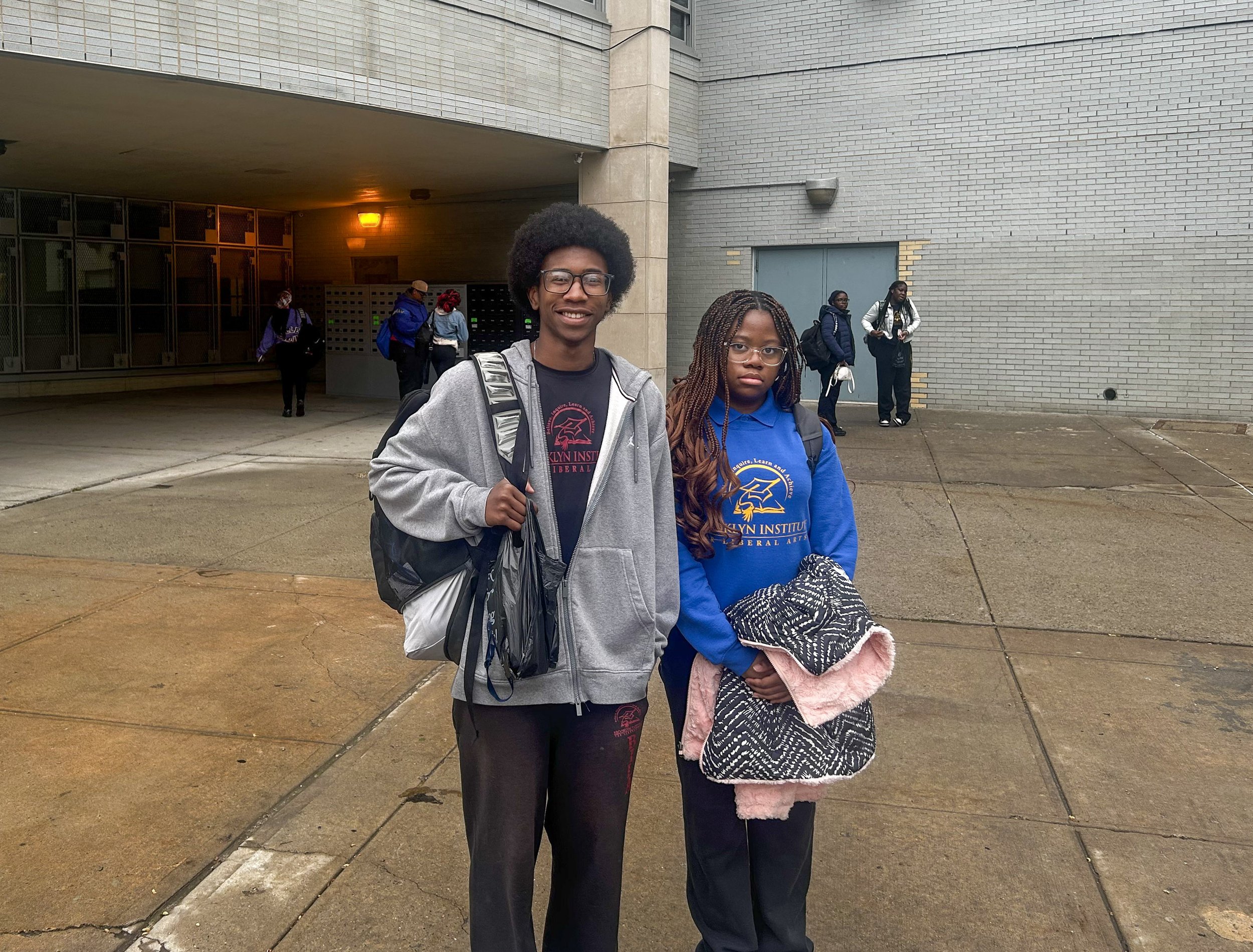
Osei Alfred, left, and Rayleen Laloi are students at the Brooklyn Institute for Liberal Arts, or BILA. Osei previously attended the School for Human Rights, which merged with BILA in 2025. Photo by Marley Campbell
The nation’s largest school system is shrinking, and one way city officials are tackling the drop: ramping up school mergers.
New York City schools enrolled 793,000 K-12 students this school year, down about 15% from the 2019-20 school year, according to Education Department data. The number of students who have left the system during this time is bigger than Philadelphia’s entire public school population. That has left the city’s school system with an increasing number of small schools that may be unable to provide their students with a full array of courses and resources.
Solving the enrollment puzzle is top of mind for New York City officials, especially as the city confronts its own budget problems. But merging schools is not always easy.
P.S. Weekly producers Rayleen Laloi, a junior at The Brooklyn Institute for Liberal Arts, also known as BILA, and Ermione Aleah Raymond, a senior at the Urban Assembly School for Law and Justice, both experienced school mergers firsthand. They explore what happens to students when two schools become one.
Rayleen talks with Osei Alfred, who attended the School for Human Rights before it became part of BILA last year. The merger changed Osei’s high school experience, for better and worse. He shares insights for schools who might be facing the same situation.
P.S. Weekly is available on major podcast platforms, including Apple Podcasts and Spotify. Reach us at PSWeekly@chalkbeat.org. New episodes drop on Thursdays.
P.S. Weekly is a collaboration between Chalkbeat and The Bell, made possible by generous support from The Pinkerton Foundation.
Transcript
Rayleen: I was a freshman when I first heard about the merger, and I don't remember exactly when it was, but there's always that one girl that somehow knows everything, and she basically came in one day talking about how the school upstairs would be merging with us. When I heard about it, I didn't really think much about it at first.
Maybe I was just a little excited about a new beginning, but it was kind of just like, the school upstairs is merging with us? Okay.
Welcome back to P.S. Weekly, the sound of the New York City school system. I'm Rayleen Laloi, a junior attending the Brooklyn Institute for Liberal Arts, or BILA.
Ermione: And I'm Ermione, a senior at the Urban Assembly School for Law and Justice, or known as SLJ.
Rayleen: Today, we're talking about school mergers. New York City public schools have been facing an ongoing issue with declining enrollment.
According to the Department of Education, public school enrollment in New York City has dropped by about 120,000 since the 2019-2020 school year. That is a lot of students. For context, that number is bigger than Philadelphia's entire school district, and it's about a 15% drop over five years.
Ermione: Whoa. That's huge.
What's causing that trend, and what do you think you learned about it?
Rayleen: Well, there's a few different factors that all have come together in kind of a perfect storm. There are five main ones that I found. One, the birth rate is declining. Not as many babies being born means not as many students that need a spot in a classroom.
Two, housing has gotten much more unaffordable here in New York, and more people are leaving the city for places where they can live for cheaper. Three, fewer people are moving from other countries to NYC. Four, during COVID, more people pivoted to working from home, and that became the norm. This meant many people who used to have to work in New York for their jobs no longer had to be there, so that also led to families leaving the city.
Five, charter schools are also growing. While public school enrollment declines, charter school enrollment has gone up 18% since 2020 in the city.
Ermione: Wow, it seems like there's a lot of dynamic changes occurring within everyday people's lives.
Rayleen: Yeah, it really is. And I became curious about all this because last year my school, the Brooklyn Institute for Liberal Arts, BILA, merged with the School for Human Rights, SHR.
At the time, BILA had 446 students, and SHR had just 144, and now because my school was so much bigger, the whole school is just called BILA.
Ermione: Well, I had a similar experience in middle school. My school also had a merger. It was a pretty tough and confusing situation.
Rayleen: How so?
Ermione: The two schools didn't get along, and it ultimately resulted in, like, a lot of fighting occurring.
Rayleen: I do feel like it's really hard to merge two schools that have their own unique cultures and social structures already established. Back in March, I asked the new school's chancellor, Kamar Samuels, his plans to make mergers as smooth as possible. This is what he said.
Chancellor Samuels: If some schools are too small, it means that they don't necessarily have the robust programs and resources for young people.
And so I think mergers can be a tool, but in order for it to be a true merger, it means that both schools have to look at the things that they do really, really well, and then merge those things together. That requires real strong work on the part of the leadership of the school, and to include families and young people in the process.
There are some really tried and true examples of how you can engage in a merger so that it limits the feeling of loss, and it ensures that both communities come together.
Ermione: The thing about limiting the loss feeling is so real.
Rayleen: I feel like every school has their own unique culture, so integrating them is always just a challenge, and I know that because of the declining enrollment situation, mergers like this are only becoming more and more common.
I want to know what's at stake for people who experience them.
Ermione: I also think it's interesting what he said about some schools being too small. It makes me think about how we were both sort of the big fish schools in the merger that we experienced. Like, it was a tough position to be in, but I also wonder how it feels to be the small school.
Small schools like SHR get merged, and essentially just sort of get deleted by the bigger school.
Rayleen: Yeah. I was curious about that, too, which is why I sat down with Osei Alfred from SHR. I wanted to talk with somebody from the school that merged with mine, and learn more about the personal impacts of these mergers on students like him.
So what was your grade at the time of the merger?
Osei: At the time of the merge, I was in the 11th grade.
Rayleen: Did you feel like you had a connection to the school? Like, did it feel like your community?
Osei: Honestly, yeah, it really did. I mostly wanna put a lot of emphasis on the teachers and staff because, like, they made it feel like family.
It wasn't like, "I just work here. I'm just gonna do what I have to do and then go home." No, they went out of their way to, like, interact with us, and they went out of their way to make sure that we felt welcome.
Rayleen: How did you first hear about the merger?
Osei: Whispers, honestly. It was mostly just whispers on the Area 53 trip.
Area 53 was a... not playground, but it was, like, a mix of things: rock climbing, zip lining, paintballs, arcade. It was one of those places with, like, all three. They had, like, a bunch of different things you could do. But the efforts to kind of mix the schools didn't really have much of an impact initially.
Yeah, that's what I'm trying to say, though. We were hanging around with a lot of BILA students, and they were just like, "Didn't you hear? SHR's closing down, so this is why they're having the trip. They're trying to get us to interact with you guys and, like, become friends." But I don't really feel like the trip had much of an impact, initially at least.
Rayleen: So this trip was before the schools even merged?
Osei: Yeah, this was in my 10th grade year.
Rayleen: Hmm. So how did you feel when you initially found out about SHR and BILA merging?
Osei: It was really late in the school year, actually. Everyone was kinda distraught, me especially. I felt like I just found, like, my second home to an extent, and then to find out that it would go from being, you know, just me and maybe, like, what?
A handful of other people to an entire school, like a proper... Not to say SHR wasn't, like, a full school, but y- you know what I mean. I feel like with the number of students, it makes it a lot more difficult to be as close-knit or as familial as SHR. You can't really compete with SHR because of the fact that it was such a small school.
Like, there, everyone knew one another, as I said before. You couldn't go somewhere and not know one of the teachers.
Rayleen: So in one of the documents for the proposal of the merger, it's mentioned that the School for Human Rights, your school, experienced a 56% enrollment decline starting in the 2019-2020 school year.
Does that reasoning feel true to you for, like, why SHR and BILA merged?
Osei: The class size was really tiny, so it makes sense, honestly. If their enrollment thing is really dropping, it makes sense.
Rayleen: Did you and your fellow classmates have any idea or guesses why the merger was happening?
Osei: We understood to an extent due to, like, we weren't getting that many students into the school, and we weren't ha- we didn't have that many students in general.
And we kind of understood, like, to keep the school open, you needed a certain amount of students, and we didn't have a lot of students. And it didn't really help that one of our teachers passed away. Another one left. It, it didn't help.
Rayleen: If you're okay with speaking about it, do you feel like that teacher passing away was, like, a big moment in your experience at SHR?
Osei: Yeah. They invited all, like, the entire school to her funeral, but that's essentially how close we were. Like I said before, everyone there was like family. As long as you went to the school, you knew all the teachers, and all the teachers knew you. And they didn't just see you as like, "Oh, you're one of the students.
Oh, well." They saw you as like a actual person. They saw you as a character, you know? So the death really impacted the school heavily. I'm not gonna lie to you. It threw everyone all out of sorts.
Rayleen: I'm sorry to hear that.
Osei: Yeah.
Rayleen: So considering all of these things, did you have any type of mindset going into the merger?
Osei: Honestly, just going into the merger, I was like, I gotta at least make some kind of an effort to be the bridge to bringing people together, you know? I went around, I was just like, "Hey." Like, I was just introducing myself to people.
Rayleen: Mm-hmm.
Osei: And, you know, I'm not really that, that vocal, but I just went around introducing myself, trying to see how many people I can get to know and just build connections.
Rayleen: Were there any things that you expected to change?
Osei: Waking up, honestly. That was my biggest issue. Like, I knew, BILA, y'all wake up really early to get to school. We got into school at least like, what, 8:50, I think, SHR did. Yeah, we got into school at least like 8:50, around there. And that time change really bothered me.
I'm not gonna lie to you. Waking up early just, yeah. But it was that, and y'all were a lot more strict, I wanna say.
Rayleen: So compared to BILA, like, what was the difference? Like, when were you supposed to arrive at SHR versus when were you supposed to be at BILA?
Osei: I was supposed to arrive at SHR closer to 9:00, honestly.
And then for BILA, you had to be in there at 8:15 on the dot or you're late. It was bothering me for a while. Like, I would have to wake up, what, 6:00 to get dressed and, yeah. It was hell to wake up even earlier than I wanted to and then drag myself to school. In comparison to SHR, like I could just wake up around my normal time and then get ready.
Rayleen: So try to remember your first day at BILA and, you know, take me through all the details. Were there any standout moments that you could really think of?
Osei: Honestly, I was really nervous, like, like horribly nervous. That's one of the main things I remember, like vividly. I was stuttering, and I sat down my... I sat down in advisory after they, they gave me my schedule.
I'm looking at it, physics, AP Lang. I'm like, "I'm not s- Who's doing physics? I never took physics before." I, most I took was chemistry, and even then I was having a hard time. I had Spanish, Spanish 2. That, I don't know why. I took, I took Spanish my last year in SHR, which I was grateful for, 'cause when I saw the Spanish homework, oh, when I tell you.
They had these thick packets for Spanish, and it was just like you had to go through and write full sentences in Spanish. I was not doing that. I'm sorry, I'm not doing that. It was really awkward the first day. Everyone just kind of avoided one another, or they went into the groups that they knew. The only time you really saw a divide was during lunchtime.
You can literally see where the SHR kids and the BIlA kids were kind of like split
Rayleen: So, like, was there any big culture shock? Like, I know you mentioned the, you know, waking up earlier and, like, the schedule initially, but, like, was there any other, like, big culture shocks?
Osei: Besides having to wake up earlier, not really, 'cause I wanna say BILA and SHR has a pretty similar demographic with it being really heavily Caribbean, whether you're Jamaican, Trini, Bajan.
It's pretty heavy with Caribbeans. So it was around the same.
Rayleen: So would you say BIlA students themselves were welcoming to the SHR students?
Osei: Um, no. To start, no. It took maybe, I wanna say three days, and then we started getting a little more integrated. But to start, no. We were heavily segregated, and no one really wanted to be the bridge or go out and interact.
I had, like, one or two friends in BilA from before, so I kind of like just hung out with them to see if I can integrate myself. But it took till maybe day three till you see kids heading from one side to the next and being like, "Oh, what's your name?"
Rayleen: Mm. Would you say the faculty was welcoming?
Osei: They were a lot more welcoming than I would expect, actually.
Miss Henry was very warm, you know. She tried to replicate that feeling that SHR had, but I still feel like she wasn't really able to do it due to the school size. Because of the fact that it was such a big school, she can't really, you know. But she was a very warm person. You know Mr. Monaco?
Rayleen: Yeah.
Osei: Yeah, you have him right now?
Rayleen: Yeah.
Osei: Yo, ask him for a granola bar. That man always has snacks. One of my favorite teachers.
Rayleen: So do you remember BIlA doing anything for the new SHR students to help you guys feel welcomed?
Osei: The trip to Area 53. It was that trip to kind of integrate us, and then there was another trip upstate to, I think, the Poconos or something like that.
But we went, again, zip lining, basketball, just a bunch of sports. I don't know if you remember it. I think that was another attempt to kind of like integrate SHR and BILA a little more.
Rayleen: Yeah. That trip was pretty early in the year, I think.
Osei: I wanna say that one actually worked 'cause the, you could see the, um, SHR kids and BILA kids just playing either volleyball or basketball, all that.
Rayleen: So you know how BILA has, like, traditions like BILAOween and, like, the talent show. How did you feel participating in BILA traditions like those?
Osei: It was fun. Being able to participate in those activities kinda made me feel still like I was part of the community. Even though, like, it wasn't as close-knit as SHR, it's, it was still a community nonetheless, and it made me feel welcome.
You know, not only being part of it, but being able to run parts of it behind the scenes. Like, I'm part of student council, so I was one of the kids that helped orchestrate the talent shows and record the talent shows. So it was pretty fun, you know?
Rayleen: Yeah.
Osei: Yeah.
Rayleen: So would you say doing these things made you feel like a BILA student?
Osei: Yeah. All the events and the parties, things like that, the trips, it made me kind of feel like I was a lot closer to- Being a BILA student and I thought, you know? Like, I went there, I was like, "Nah, I'm a, I'm an SHR kid. I'm an SHR kid." Like, we have students now even still saying, "I'm not a BILA kid, I'm an SHR student.
I'm an SHR kid till I die. I don't claim BILA." But yeah.
Rayleen: So what would you say BILA’s identity as a school was?
Osei: I can't really tell you that, but I can tell you what I think they were going for, which was unity. They were trying to push the idea of, like, we're all one school, we're one coalition in our faces a lot.
So I wanna say that especially with, like, you see the uniform. Well, SHR had a uniform too, but it wasn't so in your face, you know?
Rayleen: Yeah. Like, could you explain the BILA uniforms just in a little more detail?
Osei: Oh, the BILA uniforms are segregated by grade. So, um, ninth grade you have the bumblebees, which is, like, yellow, and you have black pants, black sweatpants.
Sophomores, they have a dark blue, I think.
Rayleen: Mm-hmm.
Osei: Juniors have, like, a brighter blue, and then seniors get to pick their own color.
Rayleen: So do you remember any incidents that happened after the schools merged that showed the difference or divide between BILA and SHR?
Osei: I was nosy. I was really nosy. There was one or two altercations.
It was just petty, honestly. It was a few petty things that happened. A few petty arguments, falling outs. That's really about it. Like, some people just stopped being friends with one another. And yeah, anytime someone would get mad, they would be like, "It's always these SHR kids, always these SHR kids." Even recently, I realized, like, a teacher had explained to me they're trying to blame the SHR kids for the grades dropping, which really blew my mind, actually.
Rayleen: That's really weird. Um, I didn't even know that, honestly. Is there anything that you would change about BILA that you think SHR might have done better?
Osei: At least at the start, I feel like BILA should have split everyone up, try to integrate the students the best they can by putting the students up into more different classes.
So the SHR kids, you have, like, six of them into a class. This way they all interact with some BILA students, and this way they all kind of integrate them into a different group. It would have been a lot faster integration as compared to if they just had them all in one classroom to themselves. So now we have no reason to go out and interact with other students.
We can just chill with our friend group.
Rayleen: The new school's chancellor says mergers need to be done in such a way that we limit the feeling of loss. What do you think was lost in the merging of SHR and Bala?
Osei: Honestly, that feeling of like, "Oh, this is my family," that feeling's gone. I feel like a lot of teachers do try, especially now, to kind of be a lot more human or show that they are kind of a lot more human, but a lot of kids don't really see it as that.
Like, even if you were a quiet student back in SHR, you would still feel like family. Cause, like, I knew a kid there, they said, like maybe what? Six words the entire semester, and I knew more about them than I know about half the students in BILA. Like they said about six words, but Ms. Babb and the rest of the teachers, I can't remember their name for the life of me for some reason, but they all made sure to interact with that student.
I know I've seen it. They all made sure to interact. "Good morning. How are you? How's your mom?" You know, stuff like that. I don't see that at BILA. I don't see, "Hey, how's your family?" But I always got asked, "How is your mom doing? How's your sister doing?" at SHR. They made it feel a lot more close and personal.
Rayleen: And what are some things that you feel were gained in the merging of SHR and BILA?
Osei: Structure, most definitely. BILA's a lot more structured in comparison to SHR, whether it be with a schedule, whether it be with trips. They're a lot more structured. Even for field day, yo, they rented two gaming trucks, had us just play basketball, football, soccer ball, whatever we wanted to do, no structure at all.
You can go wherever. They had a barbecue in the back on the basketball court, clowns. It was just fun. Dumb, but it was fun.
Rayleen: So overall, do you feel like the pros of merging outweigh the cons?
Osei: No, honestly. The feeling of being in, like, an entire family, you can't replicate that now, and you can't really bring that back.
It was such a close-knit school. I can walk in there and feel confident knowing that everyone saw me and everyone knew who I was. I wasn't just, like, a background character in the school, you know? I'm one of the school photographers for a lot of events. I'm also the photographer for a lot of trips. I just see people sit down and, and like, they try to just blend in, but in SHR you were seen, guaranteed you were seen, and I try to make sure that everyone is seen.
Rayleen: So overall, how would you say the merger affected your high school experience?
Osei: The merge kinda gave me two sides to look at. It made me feel like I should've really valued SHR a lot more because of the fact that, like I said, it was so close-knit and it was so like, I know you, you know me. I know all the teachers.
They're really close as compared to BILA, where it's just like, "You do your work. Okay, go home. Just make sure you have my work in by before the end of the week or you're gonna get, like, points off. I don't really care." That's, that's the vibe that BILA kinda gives off.
Rayleen: And is there anything that you think other schools could learn from this merger?
Osei: Try to integrate the students a lot better. Do not have the old school in one classroom because that just emphasizes the segregation a lot more.
Rayleen: Well, thank you for coming, Osei.
Osei: Oh, no problem. Thank you for having me.
Ermione: I feel like what I took away from listening to this conversation is that school mergers are not really easy or smooth. I understand that some schools are too small, but that's what Osei liked about it. He liked that it felt like family.
Rayleen: Yeah, I really noticed that too. I also think there were choices the school made that really helped.
School spirit events like BILAween and the talent show definitely seemed to help make students feel like it was all one big school. But putting all the new students in a separate class doesn't.
Ermione: Definitely. I feel like these mergers are becoming more and more common. It's important to listen to the students who experience them to get a sense of what worked and what hasn't.
Rayleen: Yeah, I feel like it's really easy to just hear the words school merger or declining enrollment. It sounds like these abstract concepts, but by listening to students from merged schools, we really understand that these aren't just buzzwords. These are policies that affect our real lives day to day.
Ermione: Yeah, I completely agree.
Osei: The BILA administration did not respond to our request for comment on the impact of the merger.
Rayleen: That's all for this week on P.S. Weekly.
Ermione: P.S. Weekly is a collaboration between The Bell and Chalkbeat made possible by generous support from the Pinkerton Foundation.
Rayleen: Producers for this episode were me, Rayleen Laloi.
Ermione: And me, Ermione Aliyah Raymond.
Rayleen: Our senior producer for the show is Maria Robins-Somerville, and our technical director is Jake Lummus.
Our executive editors are Amy Zimmer and Taylor McGraw.
Ermione: Additional production and reporting support was provided by Mira Gordon, Sabrina DuQuesnay, Zana Halili, and Katelyn Melville, and our friends at Chalkbeat. Music is from APM and the jingle you heard at the beginning of this episode was created by the one and only Erica Huang.
Rayleen: Thanks so much for tuning in, and see you next time.