Live: Student Reporters Reflect on Covering NYC Schools
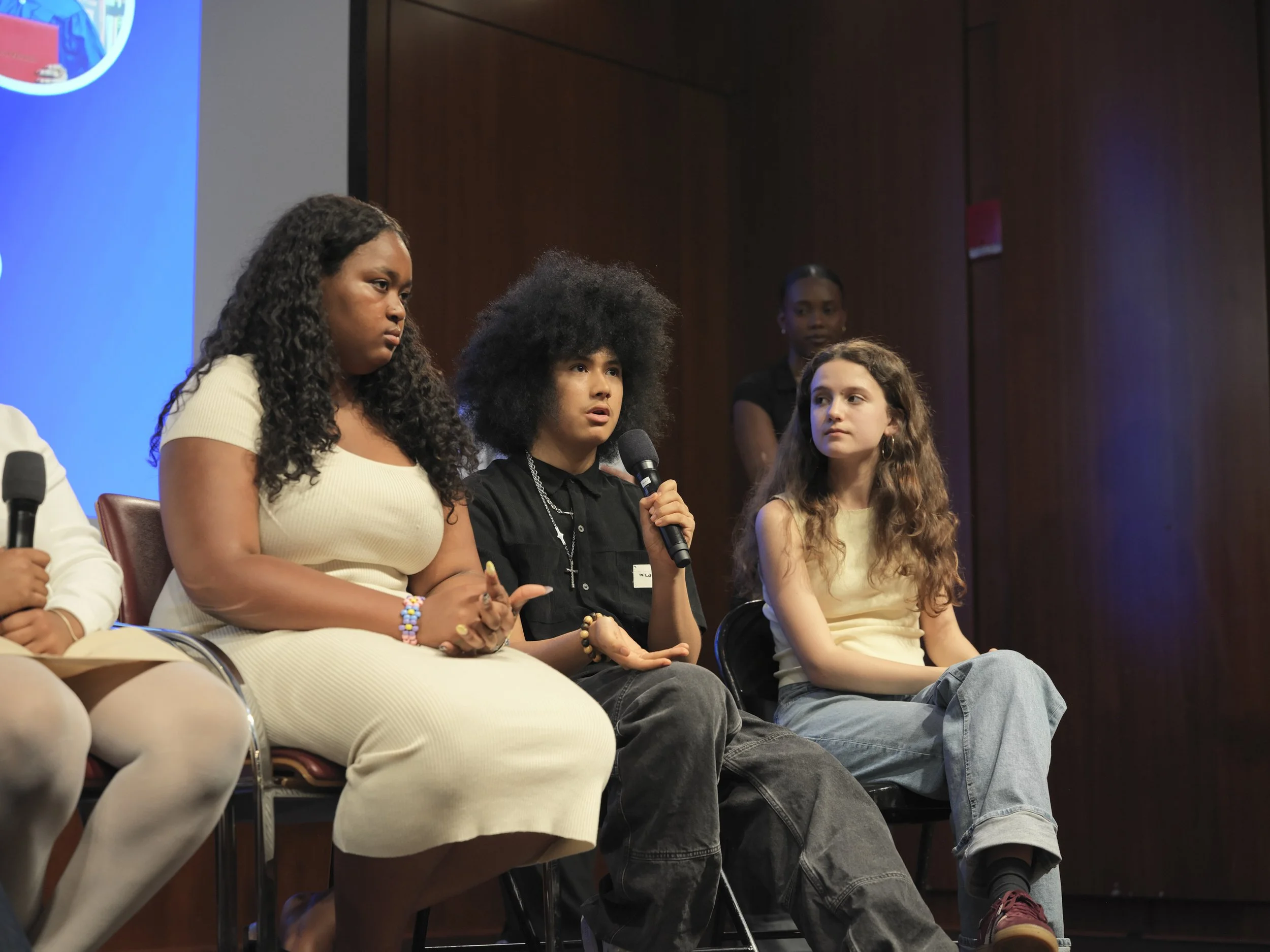
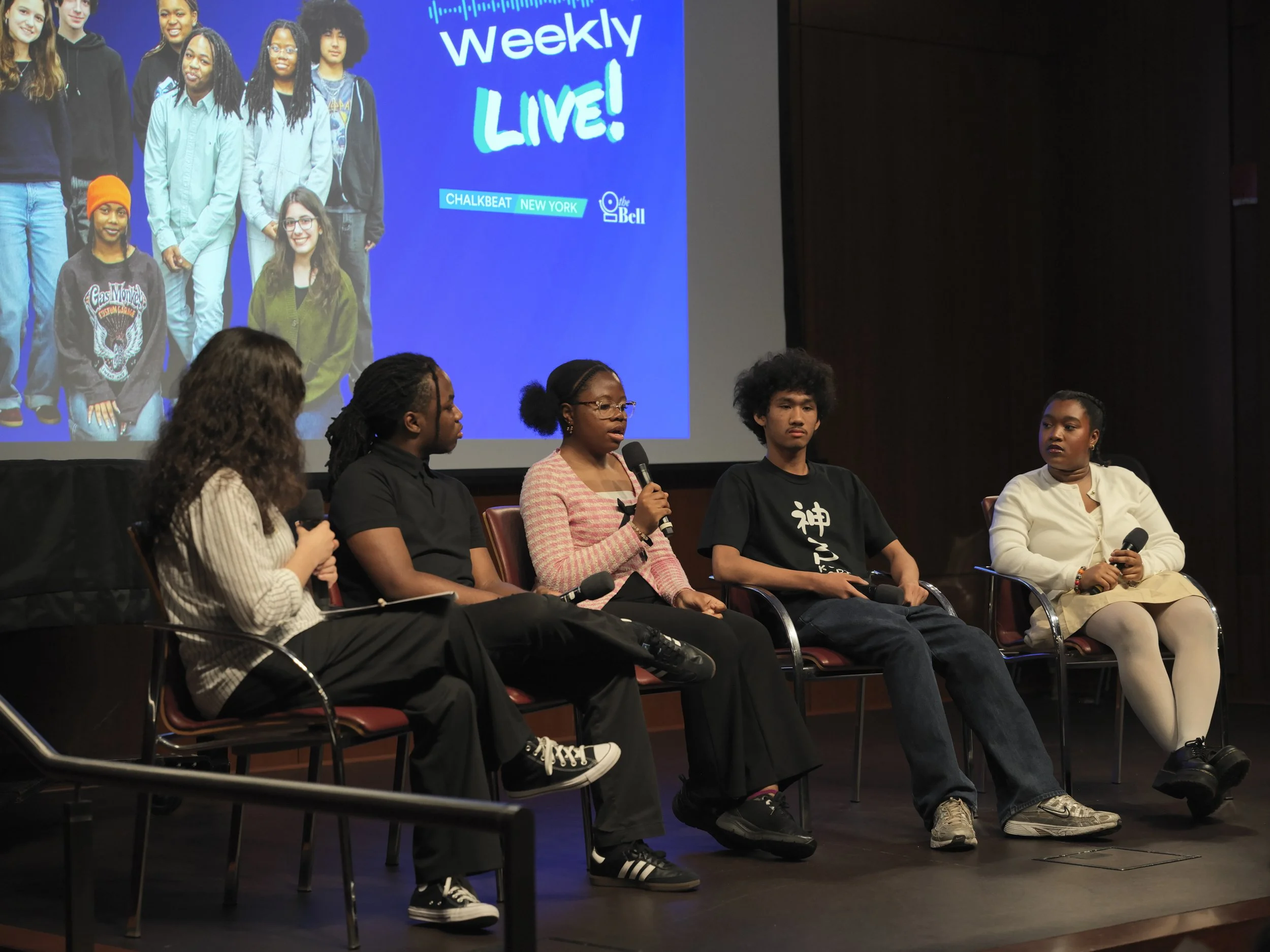
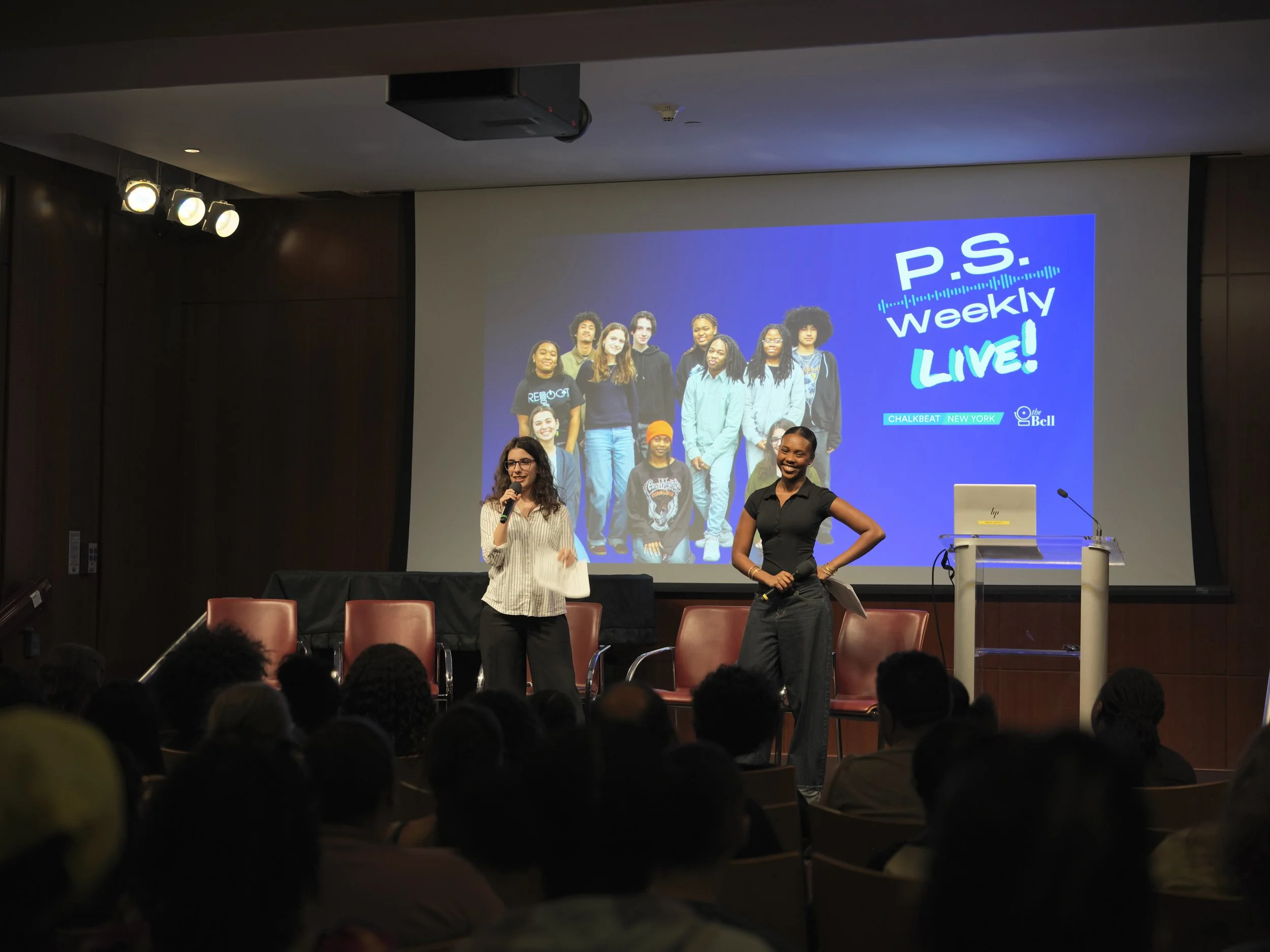
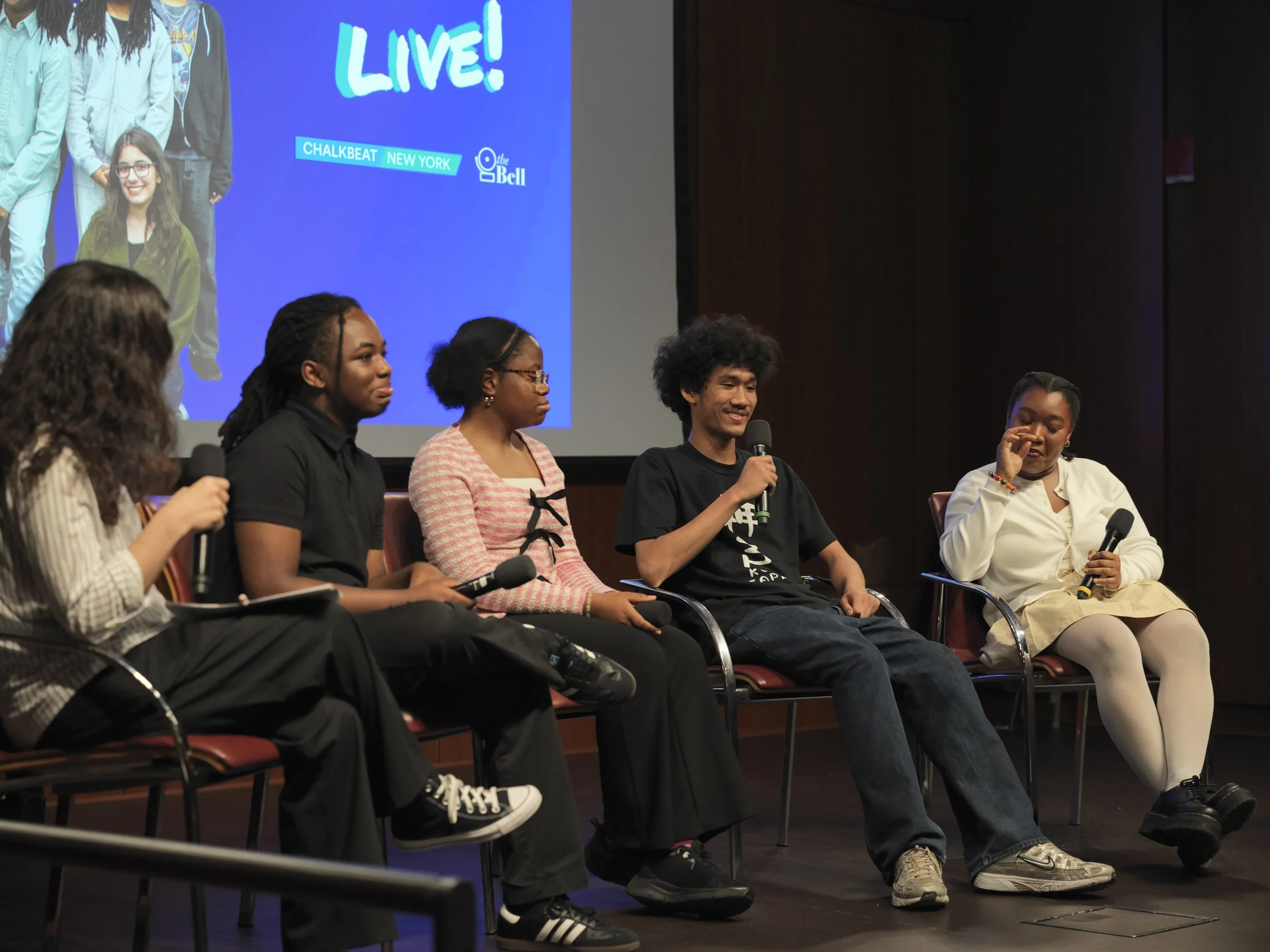
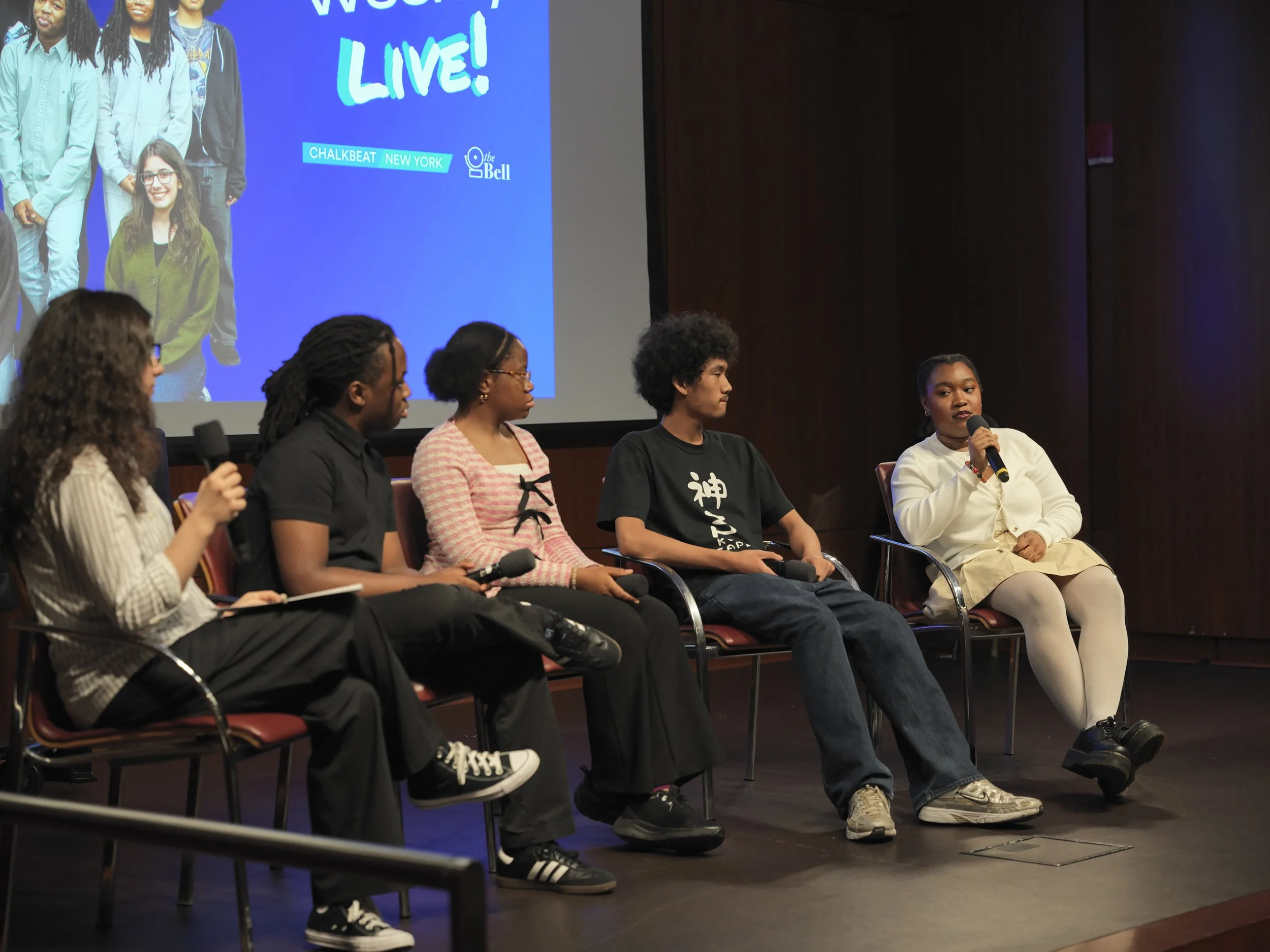
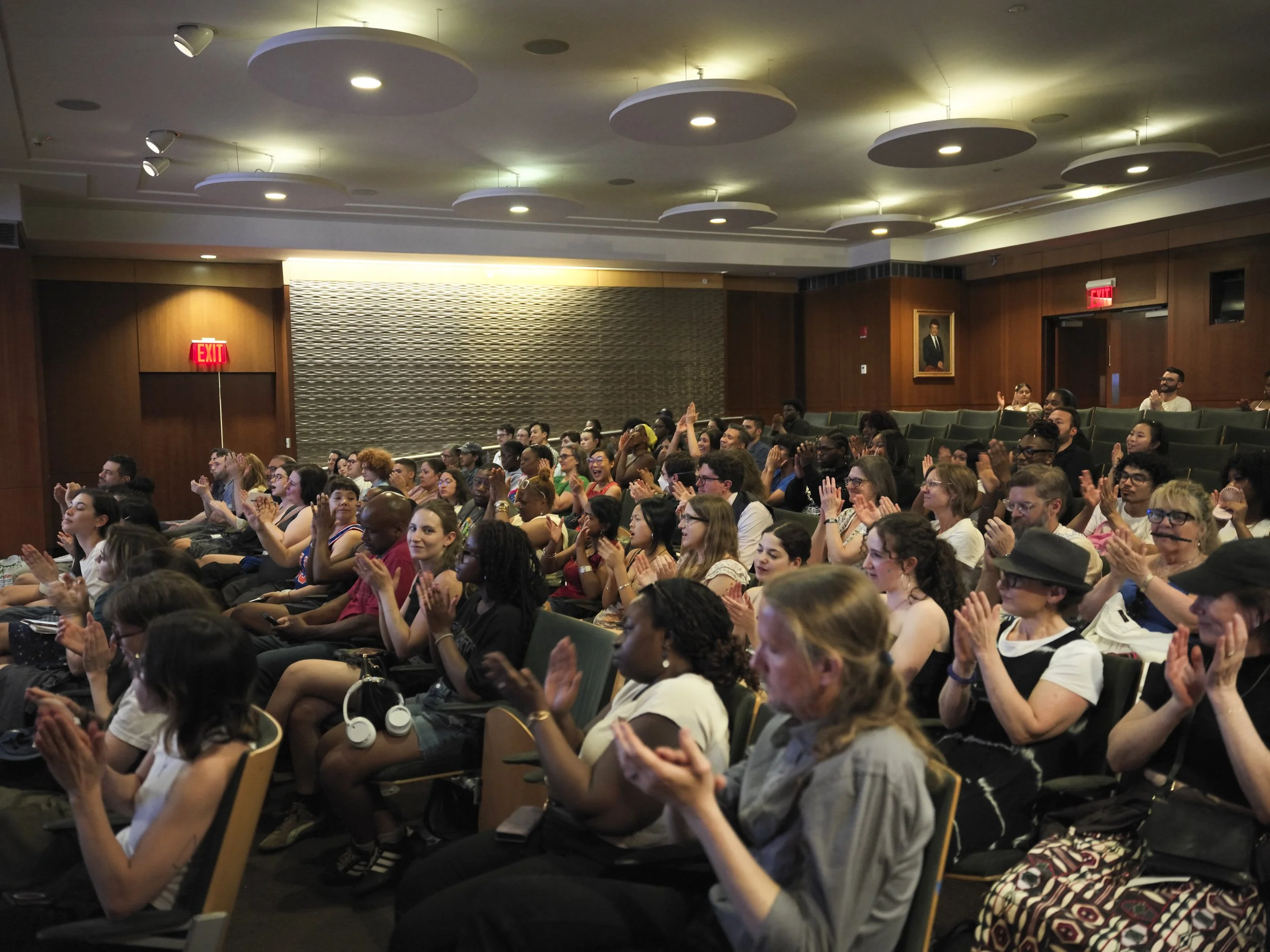
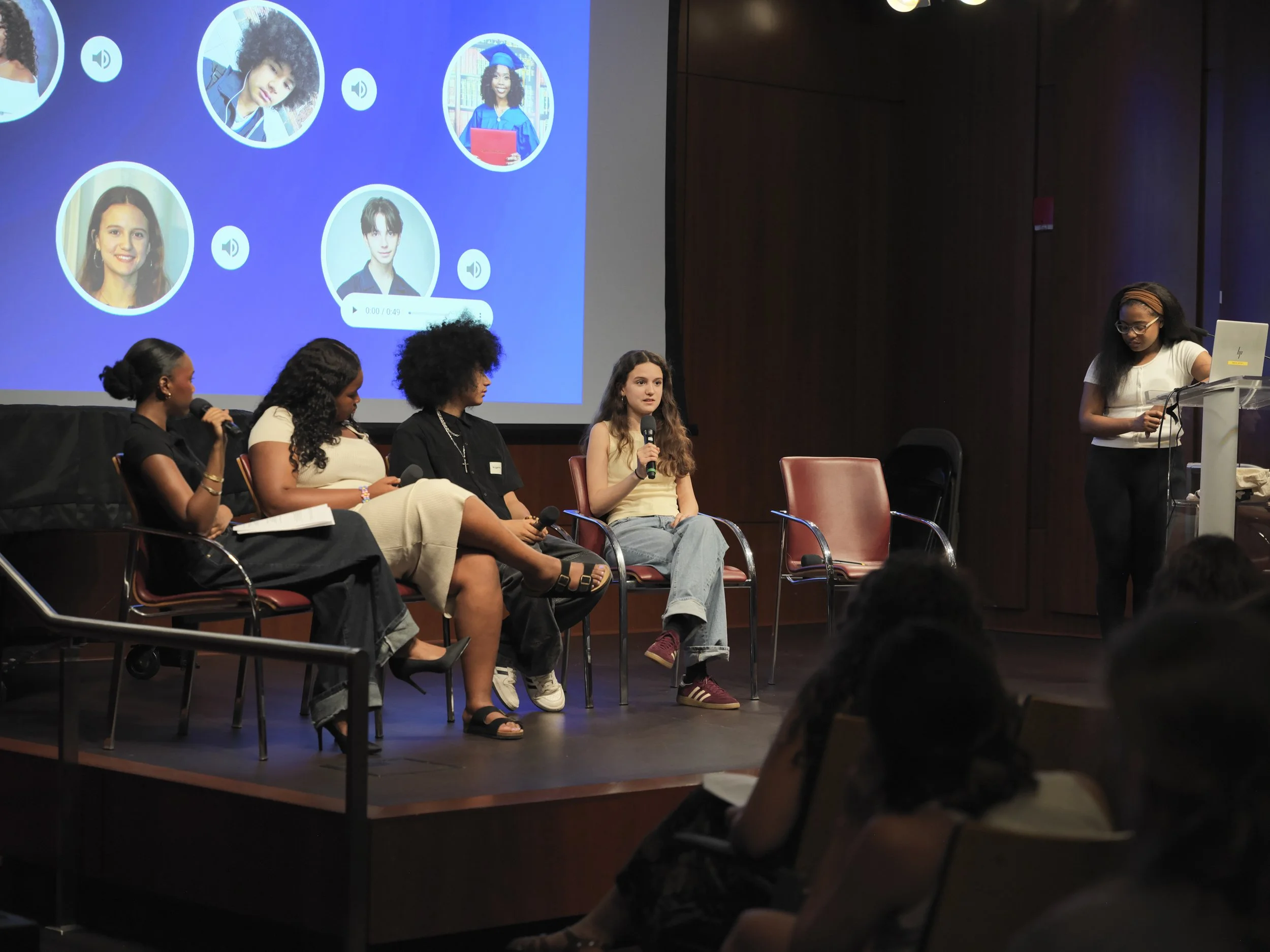
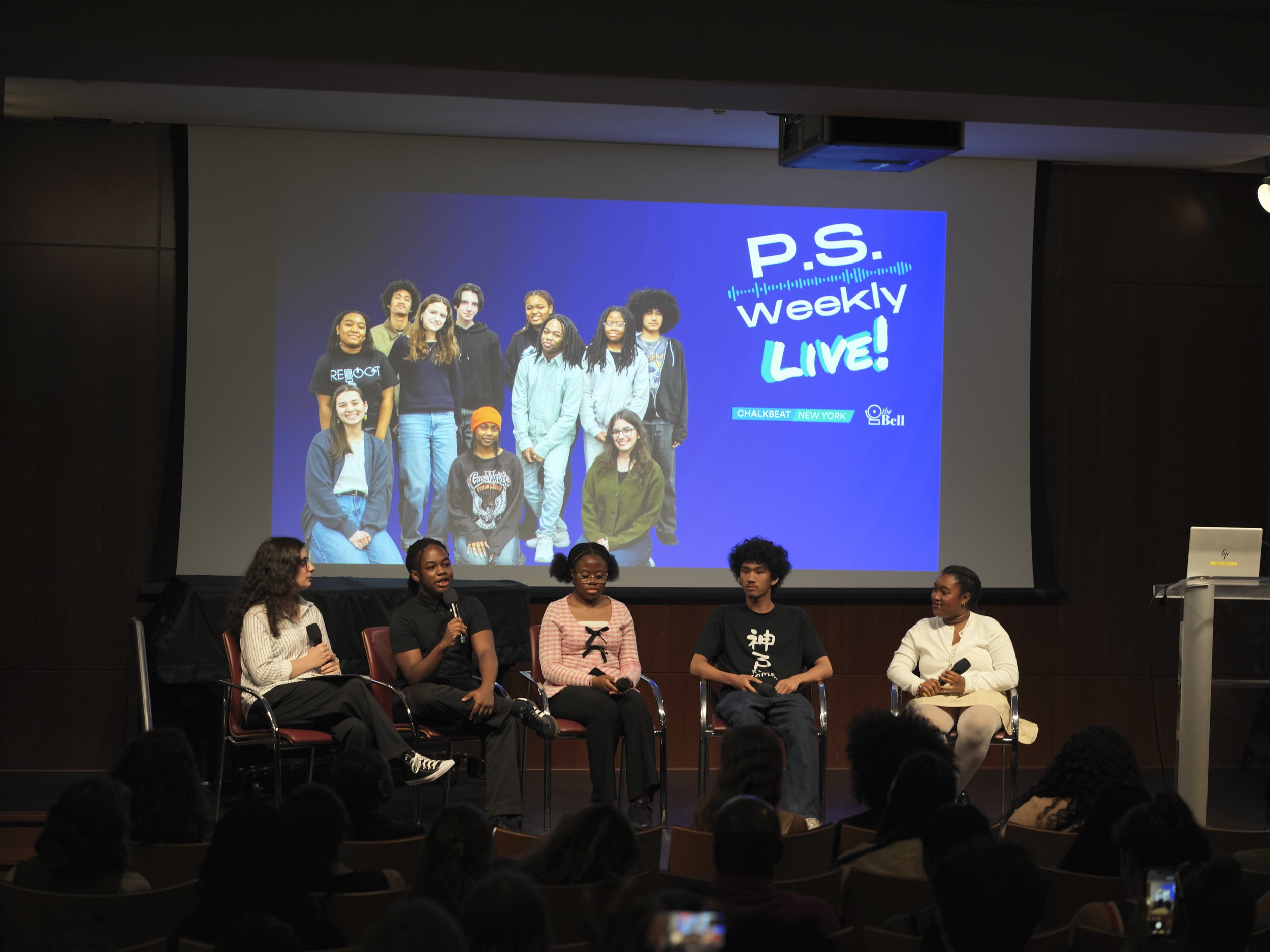
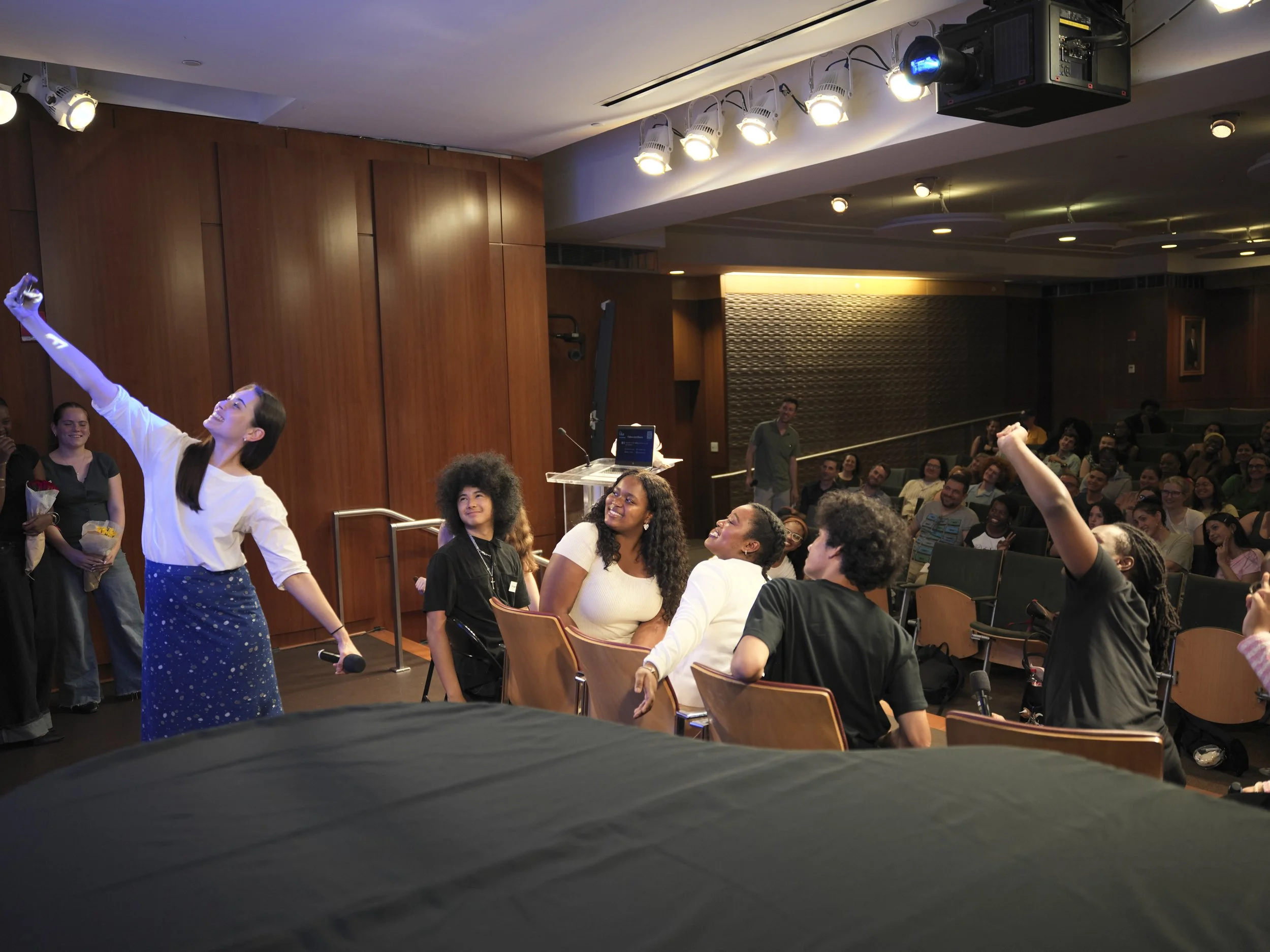
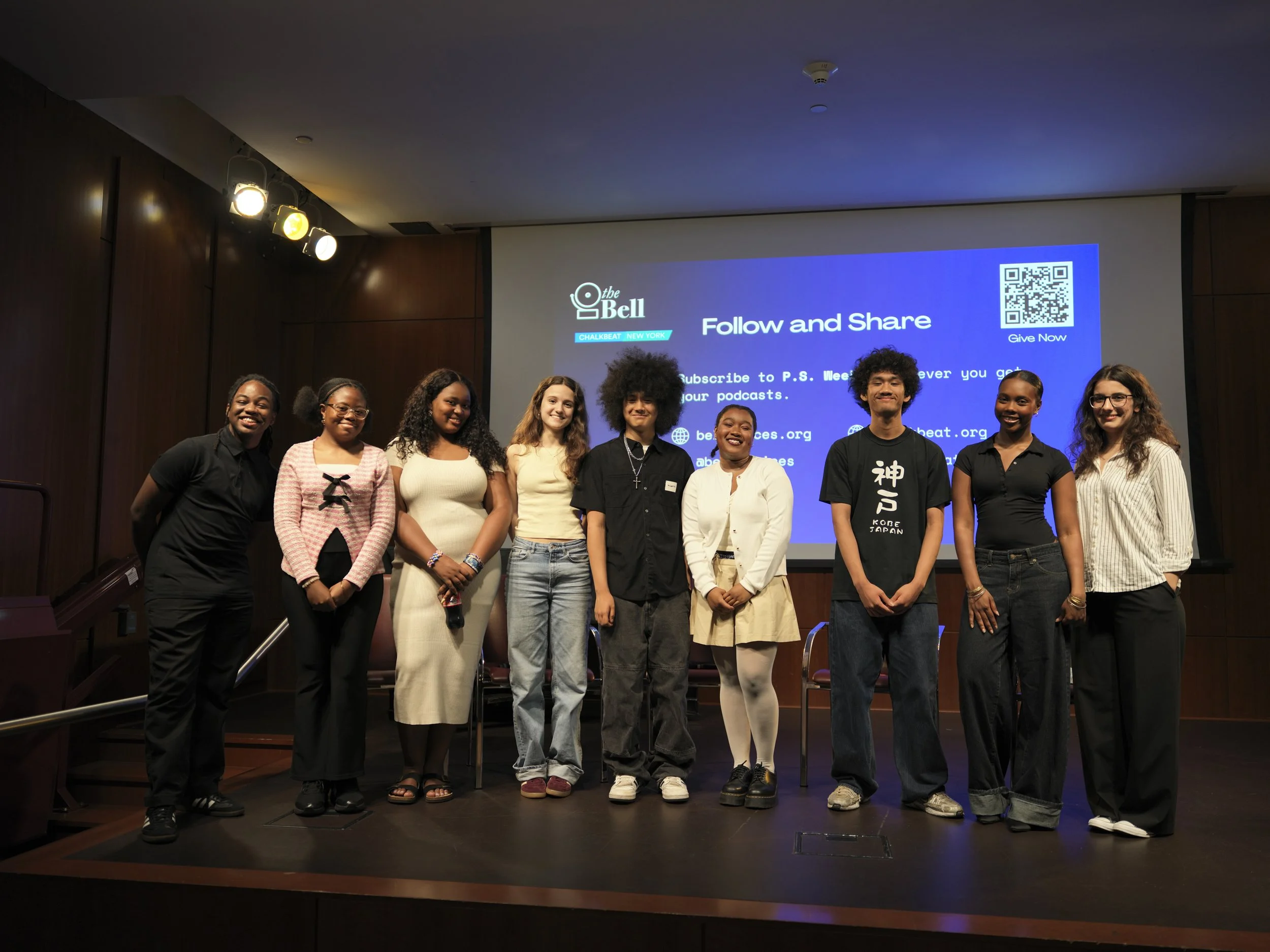
To close out P.S. Weekly’s third season, student reporters reflected on their hard-hitting journalism during a live-recorded event at the Brooklyn Public Library. Photos by Chi Tian
This season, P.S. Weekly student reporters investigated some of the biggest issues shaping New York City schools, from school mergers to sports access, teacher diversity to equity in admissions, and more.
In this special live-recorded episode from Brooklyn Public Library’s Central Branch, the students behind those stories take the mic to reflect on what they learned, what surprised them and how their reporting affected their own schools and communities.
Hosted by assistant producers Zana Halili and Katelyn Melville, the conversation features P.S. Weekly reporters Jeremiah Dickerson, Rayleen Laloi, Jasper Mallorca, Zoe George, Ermione Aleah Raymond, Mateo Tang-O’Reilly and Noa Salas Adam, with reflections from Roberto Bailey.
Together, they discuss what it means to report on schools they know personally, how young journalists can push adults to listen more closely and why student voices belong at the center of conversations about education.
P.S. Weekly is a collaboration between Chalkbeat and The Bell. It’s available on major podcast platforms, including Apple Podcasts and Spotify. Reach us at PSWeekly@chalkbeat.org. New episodes drop on Thursdays.
P.S. Weekly is made possible by generous support from The Pinkerton Foundation.
Maria: Hi, P.S. Weekly listeners. My name is Maria Robins-Sommerville, and this season, I had the delight of serving as the senior producer for P.S. Weekly I helped our student producers take their ideas from topic to story, to set up their interviews, and transform the issues they cared about into episodes for all of you.
Maria: The students did an amazing job this season, and I am so proud of them. So if you haven't listened to all of our episodes yet, I highly encourage you to go back and check them out. Recently, we celebrated their work with a live recorded episode of P.S. Weekly at the Brooklyn Public Library's Central Branch.
Maria: The event featured a student-led conversation about pressing issues in the New York City school system, and highlighted original reporting from the high school student journalists behind the P.S. Weekly podcast. It was a chance to listen to our students reflect on their own experiences and share the impact their reporting has had on their own schools and communities.
Maria: So in this episode, we're bringing you inside P.S. Weekly Live. We hope you enjoy.
Sabrina: Good evening, everyone. Um, thank you so much for being here tonight for P.S. Weekly Live. My name is Sabrina DuQuesnay, and I am the student program manager here at The Bell. So before we get into it tonight, did anybody watch the game last night?
Sabrina: Yeah. Guys, guys,
Sabrina: My word, my blood pressure was through the roof.
Sabrina: I feel like we were down 29, right? And at that point, I'm not gonna lie, I, I was ready to throw in the towel, right? And then Brunson, Brunson came in. Brunson threw it up. And then, like, it was about to miss, but you know what? OG Anunoby swooP.S. in. Knicks won by a point.
Sabrina: The crowd went wild, and it was a great game. It was legendary. And tonight is our finals game, right? Tonight is our championship. Um, and no sports involved, but we are so excited to show you guys what we got planned. So, um, for those of you who are new to our work, The Bell is a nonprofit organization that is building the next generation of journalists and civic leaders.
Sabrina: And we do that through our audio journalism internship programs for New York City public high school students, and through the Youth Journalism Coalition, which brings together students, educators, journalists, and advocates working to expand access to journalism education across the city. And we're so excited to be here tonight celebrating the work of our P.S. Weekly student reporters.
Sabrina: Tonight is a chance to hear directly from them about their standout reporting and the impact of their work.
Sabrina: And now, I'm gonna pass the mic to our amazing emcees for the evening, Zana and Kaitlyn. Please come up.
Zana: All right. Can y'all hear me? Yes. Amazing. Hello, everyone. My name is Zana. I am currently a senior at NYU, but I'm a proud graduate of Baruch College Campus High School
Katelyn: And I'm Katelyn. I am a rising sophomore at the City College of New York and a proud alum of the Brooklyn Institute for Liberal Arts
Zana: And we were the assistant producers for this season of P.S. Weekly.
Katelyn: All right, guys. So we wanna get to know the audience a little bit, okay? So I'm hoping we have all five boroughs in here, but don't worry, we're gonna find out. So if you guys hear your borough, I want you guys to cheer, okay? Okay. All right, let's start with Manhattan.
Katelyn: All right, all right. Okay, okay. How about the Bronx? All right,
Katelyn: okay. Okay. All right. Staten Island?
Katelyn: Okay, okay, okay. Brooklyn?
Katelyn: And I'm biased because, you know, it's where I'm from. We got any Queens in here? There we go. There we go. All right. All right.
Zana: Right. So glad to get to know all of you. But now it's time for you guys to get to know us a little bit better. So Kaitlyn, how did you get involved with The Bell?
Katelyn: So it was the summer of my junior year, and I started the Summer Youth Podcast Academy.
Katelyn: And after that, it's been a long journey, and I'm still here. So I did Miseducation, and then I did P.S. Weekly last spring. I reported on teacher turnover, chronic absenteeism, all sorts of things. What about you, Zara?
Zana: Yeah, so I got started with The Bell also in the Summer Youth Podcast Academy the summer before my senior year of high school, which was all the way back in 2022.
Zana: I know, I'm chopped, I'm unk, it's okay. Um, my episode was about Citibikes.
Zana: Um, and then the summer after I was an assistant on the next cohort of SYPA, and obviously now I've been back assistant producing. Um, so we've been student journalists. We've been mentors for the student journalists. So what has been your favorite part of working with P.S. Weekly, and what's been the most unique part about it for you?
Katelyn: I think my most favorite part about P.S. Weekly, the program as a whole, is that it gives students the opportunity to be a part of every single process in the journalism industry. You know, we've had students who've done audio engineering, um, writing, reporting, interviewing. Like, these students, who you guys are gonna hear from, they've done it all.
Katelyn: They've ... Like, I will not be surprised if we have some future podcast producers, audio engineers, journalists. Like, we got everything here. So that's me. But what about you, Zana?
Zana: Yeah, I've just ... It's so inspiring getting to work with these students, not to play as you guys too much. But, like, they really are so much more passionate and of the things going on around them than I was when I was their age.
Zana: And getting to be a part of that process and helping them report on the stories that they are passionate about, it's just ... It's been very fun, and it's been very rewarding for me. Yeah.
Katelyn: All right, guys. So now we're gonna have a little overview of the evening. So here. All right. So first off, we're gonna have Zana hosting a conversation with half of our student reporters, and then we're gonna pause for a little trivia.
Katelyn: Then I'll lead a panel with the other half of our student reporters. Then we'll have more trivia, and then we'll open the floor to audience shout-outs, and then our own Q&A. So you guys should see index cards and pens nearby. I want you guys to use those index cards to write down shout-outs for our student reporters, and we'll get to share them at the end of the session.
Katelyn: Um, after the program, I hope you'll join us for the reception in the lobby with some light refreshments. It'll be a chance to congratulate the students, connect with one another, and learn more about The Bell's work. And if you wanna stay connected, check out the postcard. Please sign up for our newsletter, follow up, share our work, and help us continue creating opportunities for New York City students to tell stories that matter to them. All right. Over to you, Zana.
Zana: All right. Amazing. I'm gonna ask our first four student reporters to come to the stage: Jeremiah, Rayleen, Jasper, and Zoe.
Zana: All right. So before we get into the nitty-gritty of your episodes, I'd love for all of you to just first introduce yourselves. So please state your name, your school, your grade, and as a fun icebreaker, your bodega order. You can learn a lot about a person from their bodega order.
Jeremiah: Okay, so I'll start. Hi. Hi, everyone. Um, my name is Jeremiah Dickerson. I'm a senior attending Williamsburg Charter High School in Brooklyn, and my favorite bodega order is, like, cream cheese bacon. It's very affordable. It hits the spot. It keeps you fulfilled. And yeah, that's my favorite bodega order. I'm super happy to be here today.
Rayleen: Hello, my name is Rayleen Laloi. I go to the Brooklyn Institute for Liberal Arts, and my bodega order, I'd say honey turkey on a roll, lettuce, cheese, yeah.
Jasper: I'm Jasper Mallorca. I go to the High School of Art and Design. My bodega order is probably something simple like chopped cheese, you know.
Zoe: Um, my name is Zoe George. I go to Bard High School Early College Manhattan. I'm a senior, and my bodega order is a chicken cutlet on a roll, um, lettuce, ketchup, cheese.
Zana: Now I'm hungry. Okay. Um, so before we dig a bit deeper into the reporting, I do just wanna say as a little note, please refrain from applause for the duration of the panel. We'll have a moment at the end for you all to applaud all of them, but just to keep things moving along. If you wanna, like, give a little snap or something when you hear something that you really love, go for it.
Zana: But just generally, please keep the applause to the end. Thank you. Um, so let's start off with Jeremiah over here. Hey. Um, your episode sheds light on Success Academy, which is the largest charter network in the city, and was a school that you had previously attended. Um, and for your episode, you talked to your friend Sasha, who was also a fellow student, fellow former student at Success.
Zana: So let's hear a little clip from that episode.
Jeremiah (Clip): And even though Sasha and I both left Success Academy and are happier in our new school, Sasha felt conflicted like me.
Sasha: In certain aspects, I'm grateful for, like, how they've made me who I am as a person, but sometimes I be taking a step back and I'm like, "Oof. Babe, that, that, ooh, I'm, I'm a little damaged," like, um, like sometimes I would talk to my parents and, like, obviously every conversation with your parents, it's not gonna be a great one, so you know, we're dis- we had a disagreement, and I kinda just shut down.
Sasha: Like, I stopped talking. I was just looking at them, and it was like, "You're not gonna say anything?" 'Cause obviously, like, you know how we're talking right now. I'm a very verbal person. If something's wrong with me, I'm gonna tell you. So I'm just sitting there, and I'm just, like, not saying anything, and they're like, "Are you okay?"
Sasha: Like, "You're not gonna say anything? You don't agree, disagree?" I'm just like, "I don't know. That's..." And I was just shutting down. And looking back on it, it definitely is like I, I had to deal with that from Success. When you got in trouble at Success or you're trying to talk to a teacher to change a grade or why you were late to class, it's never a conversation.
Sasha: It's a monologue. They're talking at you. They're not talking with you. So I feel like that aspect of it, it definitely affected me. I feel like there's obviously certain aspects of Success Academy where their intensity of certain things, it helps, but also it definitely did take away from my childhood and actually, like, becoming my own person naturally.
Zana: Tough to hear.
Zana: Um, obviously Success Academy has a very large presence in our city. People have very strong opinions about them, whether they are pro or against. And I know as a former student, you definitely had your own, um, strong opinions on the network, so-
Jeremiah: Absolutely.
Zana: Yeah. Um, what did you learn from speaking in depth with someone who had their own success story that was maybe a little different to your own?
Jeremiah: Um, I felt like I didn't just learn from it, I also felt like it was very inspiring to me, because for a long time as a prior Success Academy student, I felt like kind of like ashamed of my past at Success Academy because even though Success Academy is popular in the education world, it's not really the same when you're speaking to your peers.
Jeremiah: Like, when you speak to your peers like, "Hey, I went to Success Academy," it's kind of like you're coming from a horror story, you know? So, um, I kind of learned that my experience at Success isn't just like something that I experienced alone, that other people, regardless of what campus they've gone to, have experienced similar things to me.
Jeremiah: And it also like allowed me to feel more comfortable speaking to my friends about it openly, because it's something that other people have went through besides myself.
Zana: Yeah. And so what has the response been towards your episode?
Jeremiah: The response I can say has been like very interactive, like especially with the Chalkbeat post. There's so much debates. Like, I feel like that's the most inspiring thing, because I feel like especially as a journalist, your job is to get the news to people, and then also for people to make decisions about the news that you're giving them. So like just seeing people have debates about, "Hey, like I'm a Success parent. I didn't quite have this experience, but you know, this person did, this person didn't," I feel like it's just like it's reached a broader audience that really allowed them to think more deeper about their children's connection as long- along with their own as well. But also I'll say as Success Academy is expanding in Florida, it's also served as a basis for people to really like taste what Success Academy can be like for students.
Jeremiah: So it hasn't been something groundbreaking, but it's also helping on that front as well outside of the city.
Zana: Yeah, it's definitely more relevant than it has been in a really long time. Yeah. Yeah. Um, amazing. So now we're gonna move over onto Rayleen.
Zana: Now, your episode talked about school mergers and your own experience with mergers when your school, the Brooklyn Institute for Liberal Arts, merged with the School of Human Rights.
Zana: And you talked to Osei Alfred, a student who had attended the School of, um, Human Rights before it became a part of BILA. So let's hear a clip from that episode.
Rayleen (clip): What do you think was lost in the merging of SHR and BILA?
Osei: Honestly, that feeling of like, oh, this is my family. That feeling's gone. I feel like a lot of teachers do try, especially now, to kind of be a lot more human or show that they are kind of a lot more human. But a lot of kids don't really see it as that. Like, even if you were a quiet student back in SHR, you would still feel like family 'cause, like, I knew a kid there. They said, like maybe what? Six words the entire semester, and I knew more about them than I know about half the students in BILA. Like, they said about six words, but Ms. Babb and the rest of the teachers, I can't remember their name for the life of me for some reason, but they all made sure to interact with that student.
Osei: I know I've seen it. They all made sure to interact. "Good morning. How are you? How's your mom?" You know, stuff like that. I don't see that at BILA. I don't see, "Hey, how's your family?" But I always got asked, "How is your mom doing? How's your sister doing?" at SHR.
Zana: Yeah. So our current schools chancellor, Samuels, has been a strong supporter of school mergers, and he has been for a very long time. And you actually had the opportunity to interview him earlier this semester on the topic, and he emphasized that importance of minimizing the feeling of loss when schools are merged.
Zana: And obviously, you asked Osei in this clip about what he felt like was lost from SHR, but I wanna throw that question back to you. Do you feel like BILA lost anything when SHR merged with them? And how have students adapted to this change?
Rayleen: Personally, for me, I don't feel like I lost much in the merging of BILA. Honestly, I feel like I gained more in a way. I feel like when SHR and BILA merged, at first, honestly my whole sophomore year, I barely got to know any SHR students, so it never felt like we were really combined, or it never really felt like we merged.
Rayleen: But now that I'm in my junior year and I've gotten to know more of them, they're in my classes and things like that, I feel like BILA has shifted away from some of its strictness and has tried to incorporate more of the culture and just tried to incorporate more liveliness into the school that wasn't there before SHR.
Zana: Yeah. And so how has your school rep- responded to the episode? I heard there was some ninth and 10th graders that might have learned something by listening to your episode.
Rayleen: Yeah, so in my school they're doing some lessons on podcasting in ninth grade. My teacher, my 10th, my ninth grade teacher, Ms. Nahar, they're doing a podcasting unit and she played my episode for them. Yeah. Oh. And my 10th grade teacher, Ms. Hudson, she also played my episode for them, and they were confused about SHR because they weren't there for the merging of SHR and BILA, so they were like, "What's SHR? What happened? What is the situation that we're talking about?" So I thought that was interesting because I never really saw it that way as like, "Oh, I'm keeping track of, like, history."
Rayleen: But I think it's interesting how I'm just giving them a perspective on something they didn't even know happened.
Zana: Yeah, it's almost like you're keeping SHR alive somehow- Yeah ... through your episode, and that's exactly what we're all setting out to do, isn't it? Um, awesome. Okay, so moving on down to Jasper.
Zana: Uh, your episode talked about the Public Schools Athletic League, which coordinates sports for public schools in the city. Your episode specifically focused on the Access program, which allows students at schools that lack sports teams to play for teams at nearby schools. Um, both you and your interviewee, Noa Moore, who is also a senior at Art and Design, have played on teams for other schools, and you talked about your experiences, so let's hear a clip.
Jasper (clip): I have fun doing my sport, but like that-- I also wanna like have fun with the, the team. Like- Yeah ... how important do you think it is to like be able to go to practice and be like smiling to see everyone? You know what I mean? 'Cause don't you think that makes the sport more fun too? It definitely makes the sport more fun, and especially if you're-- if everybody's having fun, it unites people.
Noah: So then you start building those bonds 'cause you're sitting there, you're smiling, you're laughing with other people, you're joking with other people, and you really start to form a bond between teammates. 'Cause once the fun aspect is gone, you really don't wanna be there anymore. And so then you stop trying 'cause you're just like, "I wanna get through practice to go home."
Zana: So your episode focused a lot on Noah and his experience playing sports at other schools, but I wanna hear a little bit more about your experience as a student athlete, both at Art and Design and at the other school that you played for. So why is having access to sports important to you?
Jasper: I think it's, like, important just, like, with anything. Like, the idea of having more opportunities for students because, like, when you're a teen you just wanna try out a lot of things. So I know a lot of kids that wanted to do cross country and, like, they- they're just getting into it now, and I'm telling them, like, "Maybe you could've joined the team."
Jasper: And they're like, "Oh, I, I never even, like, knew I could do it." So it's kinda just that thing, like, you could really explore new things, like, during your teenage years only if you really have access to it. So with, like, the All Access program, like, for me at least, like, I mean, I... It was kind of the same sport I'd been playing.
Jasper: But there's a lot of people that at least I know and, like, a lot of teens are just adventurous and, like, they wanna, like, do new things. So, like, if they know about these programs, like, they would do them, and they could just get better at sports and things like that, so.
Zana: Yeah. And I know you and Noa are both very grateful for the program to have access to the sports that you didn't previously have. But what changes would you like to see within the program or within the PSAL in general?
Jasper: I mean, definitely just, like, promotion because I feel like if they promote this All Access program more, or the Access program, you can get more people from the same school that can come, and, and it wouldn't feel like you're going to a new school and having to, like, meet new people and all that stuff.
Jasper: Which, I mean, for me, like, it was kind of fun at first 'cause it's like a new, like, a whole new world and stuff. But, like, it's also fun to have, like, that personal connection to your school. Like, like, if I was running for Art and Design it would probably be better 'cause, like, I have that personal connection to my school and I'm, like, trying to, like, run the best for all the people there.
Jasper: So if there's, like, more promotion, like, you know, more people would kinda be, like, on each other's side. And that's not to say, like, like, no one's on each other's side if you're going to a new school, but there's a lot more of a... You see it, like, when you're going to a new school, like, all of them are running for, like, for me, they're all running for Lab.
Jasper: And, like, if, if it was at Art and Design, we're running for Art and Design. But you're in this, like, weird middle ground where it's, like, a whole new thing, so it's just like-
Zana: Yeah. And I think your episode is definitely acting as a sort of promotion the more l- people listen to it. So I think you're the first step, hopefully, in getting more people into the program.
Zana: Um, now we're gonna move on, last but not least, to Zoe, whose episode actually came out today, this morning actually. Um, your episode talks about your school's diversity initiative, and you talked to Jasmine Coombs, who is a Bard alum, who now actually also works at the school as the Director of Equity and Inclusion Programming, whose job it is to create safe spaces for historically underrepresented students on campus.
So let's listen in
Zoe (Clip): I think it's pretty selfless that you let 204 be more of a student lounge.
Jasmine: Well, I know how important it is to have a space, again, as a past student, to go and, and, and have your person be there or have a person who you really connect with, your trusted adult on campus, just from experience. So I would never-- Like, I know, I, I say sometimes, like, "It's too loud," or like-
Jasmine: "Quiet down," 'cause it is my office and I have to get work done. But I, I really do believe in offering a space on, specifically at Basic Manhattan, for my students, my Smart Scholar students, to come to and to really decompress. Um, because I know how stressful it is in those classes. I know how stressful it is to, like, be cold called on a day where you're just not feeling it, or to not come to class prepared, or to, like, have just finished a test where you thought that you were gonna do well, and then you finish and you were like, "Mm, that didn't go too well."
Jasmine: So I know how, how it feels to, like, need a space. I think that the safety, in my eyes, has a person connected to it, and I'm happy to hear that that's me for you. Like, it can't just be a space without someone kind of making it intentional, if that makes sense.
Zana: Yeah, so I absolutely love this episode. You and Jasmine just have such a great rapport. Yeah. Um, you guys talk about the importance of safe spaces. What does a safe space look like to you, and what do you think teachers and admin need to know or need to do in order to create one?
Zoe: Um, yeah, I think I got into that in the episode a little bit, um, that a safe space is a place that somebody can go, or multiple people can go that, um, are not only seen but heard.
Zoe: I think seen is the first step, but being heard is the second. And not only just being heard as well, but also being understood and knowing that people can relate to you. Um, I think that it doesn't necessarily have to be a location, but having a space, like a physical space helps, and having a person attached to it helps a lot more to have someone guide you through that situation or the, um, system in which that you don't feel safe and need a safe space is, is helpful.
Zoe: I do personally believe that, um, we should be working towards making all safe s- all spaces safe, um, and not needing necessarily a safe space if all of them feel like you can be heard and understood. But that is a very long process that, like, this help, episode helped me understand. So I do think that maybe schools and administrators, um, can kinda like...
Zoe: I hope that this episode resonates with them and can, um, recognize the importance of safe spaces in their schools and know that that's the first step to making our students feel not only physically safe, but also emotionally and mentally and even intellectually safe as well.
Zana: Yeah. And I also know that you're very passionate about the idea of third spaces, um, first of all, I would love for you to talk a little bit about what third spaces are and why you think that they're necessary for young people.
Zoe: Um, yeah, so the saying goes your first space is your home, um, then your second space is your work or your school or whatever, like, um, institution you have to be in, and then your third space is a space that you can go to kinda be authentically you and be yourself or relax or kinda take a load off or just work through whatever you need to.
Zoe: And think the conversation that me and some of the people in this program were having was, sorry, that many times teens are banned or barred from these safe spaces. Like, we referenced, um, like things like the mall and like closing out teens or like after COVID cafes shutting down and there being like spaces for two to six-year-olds and then there being a gap.
Zoe: There's elementary school spaces, um, but there's a gap in like s- for students who are teens and how I think that we need to have a reemergence of that in the city. We have a lot... We have a big student population in the city. We have a big teen population in the city, and I think that there's certain institutions being, d- doing the work to open them again.
Zoe: But again, we constantly face kind of, we are one of the biggest groups that constantly face getting barred when you talk about age, like getting banned from places 'cause we're seen as rowdy or rebellious, and I think that many take a certain group of teens and kind of make them the Um, figurehead for the entire population, which shouldn't be done. Just my personal opinion.
Zana: Yeah. And I mean, it's a great - conversation to have in a place like this, as we are currently in a library, which is in fact a third space. Um, so now I'm gonna go into just one big question for all of you. You can answer however you'd like. Um, all of your episodes focused on, on an issue within your school or within a school that you had previously attended.
Zana: What message would you like to leave for the teachers or the administrators in the audience tonight about your experiences?
Jeremiah: Um, I'll keep it short. Like, honestly, just to say, like, administrators and teachers, you should just, like, value the opinions of students more, you know? Because I feel like even with my experience reporting with The Bell on countless other stories, there's been times where teachers just haven't been receptive to me, like, saying, "Here, I'm here to report," or, "I'm here to interview you."
Jeremiah: But just, like, regardless of, like, what age someone is that they're interviewing you, it honestly takes a lot of courage and dedication to do so. So all I'm saying is just, like, give the child or whoever's interviewing you that amount of respect regardless of their age
Zoe: Um, similarly that's, similar to that I'll say, like, check your bias at the door. Um, I think that whether that's your age, your, your race, your gender, your ideas, I think that many kinda shut off towards that type of, um, environment or just that space. And make sure, like talking about my episode, that students feel more safe to communicate and, um, express their ideas
Jasper: Um, I think like the teacher's goal shouldn't be like fully to make the students like the best student. I feel like they should kinda go in like, "Oh, I want the student to know like they could really do anything." And I mean, for me personally, like I think again, the idea like promote these sports teams, like make like the, the teens like feel like they want act- like they could actually do what they want in a way.
Jasper: Like don't shut them out of certain things and really make sure like the teens could do what they want and have like all these different opportunities. But like even beyond that, like I mean, some episodes are about like AP calc. Like make it like beyond like the math. Like really like, I don't know, like talk about like real life.
Jasper: Like make the teen feel like connected to the subject and interested and realize it's like beyond school. It's like, it's about making connections, like trying to build out your future and like trying to really just be happy. And I think it's beyond just academics.
Rayleen: I'd say teachers shouldn't be afraid to push students out of their boundaries when it comes to being inclusive and diversive, diverse, you know what, yeah, in school. I feel like too many times teachers just allow students to sometimes be too, to themselves and not push them to do things and meet people and interact with people that they maybe wouldn't before or do things that they wouldn't before.
Rayleen: I know that, you know, last year, I don't think I would have ever done this, and my advisor, Ms. Nahar, she just let me know about this program through, you know, texting the Google Classroom and things like that with opportunities. So I feel like teachers just shouldn't be afraid to try and push students out of the bounds of what they think they can do or what they should do.
Zana: I hope all you teachers in the audience were taking notes. All right, so that is it for our first panel. Can we please get a round of applause?
Zana: We are going to transition into the first trivia moment, whoo., of the night. Um, so this is how it's going to work. Um, I'm going to pose a question to the audience, and whatever student, student in the audience thinks that they know the answer can stand up. And if you are the first p- person that I see to stand up, I will call on you, and you will have the opportunity to answer the question.
Zana: Um, if you get it right, um, our lovely manager over here, Sabrina... Stand up, Sabrina, so everyone knows you. She- Come find her at the end of the night. This is an opportunity to win fun merch and other prizes for the night. So, all right, are we all ready for the first trivia question? Okay. Early in the season, our students interviewed a really important figure.
Zana: What is the first and last name of the current New York City Schools chancellor?
Katelyn: Yes, you know it.
Zana: Yes, that is correct. For those of you who may not have heard, it is Kamar Samuels. Uh, our second question, New York City's largest charter school network, Success Academy, recently announced that it is expanding to which state?
Zana: Yes. Okay. All right, so you two please find Sabrina at the end of the event. Awesome. So now we are going to be transitioning into the second panel of the night, so come up, Katelyn.
Katelyn: All right, guys, how are we feeling? Nice to hear it. All right, so now we're gonna hear from the other half of our student reporters. So Ermione, Mateo, and Noa, can you please come up?
Katelyn: All right, guys. So I want you guys to just go on rapid fire. I want your name, your grade, your school, and then for our little icebreaker question, can you guys tell me your favorite train line?
Ermione: Hi, my name's Ermione Aleah Raymond. I go to Urban Assembly School for Law and Justice. And this is a hard question, you know, 'cause numbers, letters. Um, I would say the 2 5 simply because I've lived in the Bronx and I now live in Brooklyn, and it's a easy, direct route.
Mateo: My name is Mateo Tang-O'Reilly. I'm a junior at Central Park East High School. And I would say the A because, like, I take it every day, and then also the 7 'cause the views are nice.
Noa: I'm Noa salas Adam. I'm a junior at Stuyvesant High School, and probably the B. I take it the most often.
Katelyn: All right, perfect. Thanks, guys. Well, those are better answers than I would give, 'cause I'd say the Long Island Railroad, but, you know, whatever. All right, but let's get to these clips.. So, Ermione, your episode sheds light on the importance of teacher diversity in schools.
Katelyn: You interviewed a college student named Isaiah, who's part of New York City Men Teach, an initiative that supports men of color on their journey to becoming New York City public school teachers. Let's listen to a clip.
Ermione (clip): You're in your first year of college. Yes. You're in this Men Teach program. Can you walk me through a typical day-to-day in the program?
Isaiah: Yeah. So basically under Men Teach, I have schooling in the morning, of course, and then 1:00 I will go to the school that I'm assigned to for the last hour and a half of, you know, the school day. Then I will transition to the after-school program with, you know, with the school, and I'll help teach the kids there as well.
Ermione (clip): Hmm. So in a way, you're both getting the educational background of teaching, but you're also getting the hands-on experience. What mission do you feel like you're contributing to by being a part of this Men Teach program?
Isaiah: Paying it forward. You know, they can see a face that looks like them. You know, I would say just giving them like a, a good image, a good positive role model. You know, that's important to me for them to see that, okay, this guy looks like me. He, he works in the same way that I can work. I could become him in the future. Just to pay it forward so they can see that, oh, they can become me, or they can do something similar to pay it forward.
Katelyn: All right. Perfect. Thank you. So Ermione, a theme I noticed in this clip is the importance of students feeling seen and supported. Through your reporting, did you come away with a different understanding of why having teachers who reflect the background and experiences of their students is so important?
Ermione: No, I didn't come away with a different understanding. I felt like it reinforced, like, interviewing Isaiah reinforced the same idea in a sense, simply because his program is very similar to what I was trying to find or seek out through my podcast.
Ermione: I was looking for something to help alleviate the, the gap of teacher diversity. And I think that hearing his passion and hearing his story to teaching reinforced the idea that teacher diversity is important, and it reaffirmed my, I guess, desire to continue fighting for this passion.
Katelyn: All right. Perfect. Thank you. And just a quick little follow-up, did you have, like, a personal experience that drove you to report on this story?
Ermione: Yes. Um, so my favorite teacher, love him to death, but he would call me a grade grubber. And I thought, like, grade grubber, negative connotation, and a lot of high-achieving students get that kind of joke o- oftentimes.
Ermione: And it really center- it kind of centered my learning 'cause senior year you care about your grades, colleges, this, that. Like, it's a very important time, and you shouldn't be looked down upon for caring about your grades. But I felt like oftentimes high-achieving students, instead of getting the support they need, they tend to get brushed aside, which is understandable.
Ermione: Our education system, teachers are overworked, but where do we make room for students who actually do care about their learning and wanna further it? So his kind of joke kind of spiraled into, like, the podcast, and me think about how he wa- he is a white teacher, and my school is majority white teachers, and how that differing understanding contributed to me.
Ermione: I'm a Caribbean student. Um, I'm ... I was raised by a single mom, lower income. I meet all the kind of brackets for not succeeding in higher education or education in general, so just understanding how my background and his are different, different, and how that contributes to our different understanding of what learning means to me.
Katelyn: All right. Thank you, Ermione. All right. So Mateo, you interviewed Dash, an AP Calculus teacher from Young Women's Leadership School of Brooklyn, and a member of Math for America. Your episode talked about the usefulness of AP Calculus and its usefulness beyond standardized testing. Let's hear a clip.
Mateo (clip): So for students who have no plans to become engineers or any profession that uses advanced math, what do you think the benefits of a calculus class are?
Dash: It's true that once you get beyond, like, eighth grade Algebra 1 level math, you're not learning a lot that's gonna come up in your everyday life, but that's okay.
Dash: That's the case for your other classes, too, right? You're not necessarily doing literary analysis or explaining mitosis or the Seven Years War or whatever. A lot of what we learn in school is not directly applicable to our lives, but it's still valuable. It's still part of our shared knowledge. It's a way of discovering what you want to pursue, right?
Dash: You're not gonna know what you wanna do as a career until you've seen it at least a little bit, and that's part of why we want to introduce students to all these things. So I think there's value there. And as I was saying, I think with a lot of this more advanced math, even if you're not using it in your life, somebody is.
Dash: Like, there are jobs out there that are relying on these things that do affect you in different ways. Whether it's, yeah, the space program or disease control or finance or whatever else, there are ways that these things get used, and if it does affect you, then I do think it's worth understanding
Katelyn: Thank you. All right. So I will say I'm a little bit biased being a student who kind of pivoted into, like, STEM because of really great, um, really great teaching from, you know, my teachers and everything like that. So I wanted to explore what Dash was talking about, how most subjects' curriculums are not also directly real-world applicable. Did speaking to him change your perspective on the way that other subjects are taught as well?
Mateo: Honestly, I would say no. It kind of confirmed what I was already thinking, just because, like, obviously a literary analysis or, like, cellular respiration is not as applicable to our lives than, like, learning how to do your taxes.
Mateo: But I feel like it's easy, I guess, for me at least, to see, like, how that unfolds in the real world. Like, you can see that it affects our day-to-day. I think for calculus, it was a bit harder, and what he said kind of made me realize how important it is that we know, like, where calculus is applied. Like, in the episode, he talked about, like, calculating income inequalities across countries.
Mateo: Like, I had no idea that was happening with calculus, and it just feels comforting to know that, like, something like calculus doesn't really seem like you can apply it to your life, does have a use outside of, like, boosting your GPA or, like, appealing to colleges, you know? So I feel like it's, like, a sense of comfort for me, and I hope other students in the audience or who listen to the episode also share that sense of comfort.
Katelyn: All right, thank you. And a little follow-up because I know your episode received a lot of positive response. I know I showed it to a lot of people. So can you talk about the response that you received from your episode?
Mateo: I feel like it was both expected and unexpected, like the response I got. It was expected because the goal of the episode was to kind of like appeal to other calculus students who may feel like what they're learning is not really applicable to their lives if they're not going down like a STEM route, and that was kind of the response I got from students.
Mateo: I think the unexpected part was like how many people came up to me, like students I'd never talked to, like DM'd me or talked to me like in my calc class. And then my history teacher came up to me and she was talking about how like one of her teacher friends from Long Island sent it to her on WhatsApp, and I was like, wow, like Long Island, like that's like- you know? But yeah.
Katelyn: All right. Thank you, Matteo. All right, so now on to you, Noa. So you spoke to Lucas and Paulette, a mother-son duo who experienced the issue of inadequate school busing and how much it impacts students with disabilities firsthand. Listen to a clip
Noa (clip): Yeah, Lucas, could you tell me about that feeling of being left out when your friends are at school, but you couldn't be there because of the unreliable busing?
Lucas: Well, let's just say I just, I didn't like it when I was left out, and because of that, I felt, well, lonely because I wasn't there, and it's, it's definitely not fair.
Lucas: It's literally, like, not fair to be left out. I mean, what the heck?
Paullette: It still hurts you now.
Lucas: Mm-hmm.
Paullette: And you're, you're 18. It was 10 years ago. So it's like these are, these are the kind of scars that nobody sees on the outside, and, you know, sometimes I don't even realize, like, how raw it still is for him, you know, until I hear the anger in his voice, just like I did just now, and hearing him say, "I felt lonely."
Paullette: Like, no mom ever wants to hear that, you know, from their kid, and- Mm ... and not being able to fix it, so.
Lucas: Yeah. That's what's going on with my life with busing, busing problems and stuff. I just really wish I was there back then.
Paullette: Yeah. And I know, I know that also makes you more empathetic to your friends, too.
Paullette: Like, when, when you're, you, you come home and you tell me that one of your other friends wasn't able to get to school 'cause the bus didn't show up, like, I know that you know how that feels, and you worry about them, and you worry about how they're feeling. And yeah, it hurts, no matter how old you are.
Paullette: Whether you're in third grade, in middle school, in high school, it just sucks not being able to, to be part of, you know, everything that's going on, especially this being your last year of school, too.
Lucas: Yeah.
Katelyn: All right, Noa. So for you, and just like a little anecdote, I got to see like Noa firsthand put this episode together, and I will say that she practiced so much intentionality in the message that she wanted to put through to our listeners. So when you were putting the episode together, what did you hope listeners would understand about disability and accessibility that they might not have understood before hearing Paula and Lucas's story?
Noa: I think that a lot of the time issues like this where you're talking about a big system, you know, the school bus not coming, being late, a lot of it is in, like, numbers, which that's important, right? Even the fact that 43% of the 145,000, um, New York City public school kids who rely on the bus each day, um, have disabilities, that's important.
Noa: That's a big number. But I think with this episode, the power was really in hearing a specific story, and so I was so grateful to be able to talk to Paulette and Lucas together, how they kind of build off of each other, and getting both of those perspectives because it really helps you realize, like, these are, this is an issue that impacts someone, so many people every single day.
Noa: I mean, it makes me, like, sad hearing now even, again, Lucas saying that it made him feel lonely to miss the bus, you know, or the bus missed him. But, um, yeah, it just, it really humanizes something that can seem so large. And to think he, in third grade, he missed 56 days of school, I think. And so when you hear that, you're like, it's just inc- credible.
Noa: Um, so instead of maybe thinking about a big system and the problems, when you can hear very specifically, like, he's 18 now, and it still really affects him. I think I just wanted listeners to be able to hear some- something like that 'cause I didn't really realize how big of an issue that unreliable busing was for students with disabilities until I worked on this episode.
Katelyn: Yeah. And I just want to follow up, kind of like talking about how, you know, you weren't aware of this issue. You know, very briefly, if you can kind of like take me through how you settled on this, um, issue for your episode and that kind of light bulb moment that you had.
Noa: Yeah. It was kind of a, it was an interesting process because I met a group of parents of students with disabilities who are also advocates at an event, and then I realized, like, this is what I wanna report on.
Noa: But I wasn't sure. I knew it can so easily just be like a topic, so I knew that I needed an angle. Um, and I was originally thinking maybe, you know, getting into, um, more advanced classes maybe with an IEP, um, which is in, which, you know, would have been a great topic as well. But then I spoke to one, I did so many pre-interviews, and, um, I learned about busing and how that was a big issue that nobody really seems to talk about.
Noa: And so I interviewed many different angles and then was connected with, um, Paulette and Lucas. And being able to talk to them as a mother and son, I think that was probably the most powerful thing, and realizing that I needed something really specific to really show how important the issue was. Perfect.
Noa: Thank you, Noa.
Katelyn: All right, guys. So as you can see, we do have an empty chair right here. So unfortunately Roberto couldn't make it here today, but his clip comes from his interviewee, Kassidy Khuu, a junior at Hunter College High School and an organizer of Hunter College High School for Equity, a student-run group created in order to address the equity issues in admissions at Hunter.
Katelyn: Roberto's episode takes on a unique perspective, being that he himself is a student at Hunter and also a part of Hunter High School College for Equity. Um, he has been since his elementary education, and yet still finds the equity issues glaringly obvious among the school culture. Let's hear a clip
Roberto (clip): So if you could leave listeners with one message about equitable admissions processes, like what you want them to kind of take away from this, what would that be?
Kassidy: I think my message would be an action, and I think the action should just be talk to people in your life about this issue. Talk to how, especially if you're invested in equity in other ways in your adult life, if you're an adult listener, talk to people about how education is such an instrumental part of that.
Kassidy: And if you're a high schooler, talk to the people in your school about what they think about the structure of your school and the structure of how they got to that school, what the system is in New York City as they've moved through it, because I feel like it can definitely open exciting conversations on how we can change the situation we have right now and how everyone is connected to this movement.
Katelyn: And just to speak a little bit about his episode and things that, you know, I've heard just from, you know, seeing him work and just, you know, being his friend as well, um, I think it's very brave of him to kind of explore this issue at a school that he already goes to. You know, he had spoke to me about how administration definitely pushed back on him.
Katelyn: Even his own friends and classmates pushed back on him, you know, and he felt a lot... He felt like very, like stigmatized, you know, for speaking out about this, you know. Being a very high-- like being a student in such a prestigious and high achieving high school, you know, he was talking about how students are expected to kind of just like fall in line and go along with everything that's happening and kind of see themselves as being the elites.
Katelyn: But he was like, "That's not necessarily true." You know, you can't be a New York City high, high school. You know, when New York City is the melting pot of the United States, you can't be an equitable and responsible high school, you know, and preach that you have the best students in the entire, in the entire city when you don't have an equitable amount of Black and Brown students and students with disabilities and, you know, minorities.
Katelyn: So he also shared with me a quick reflection. So he says, "I think my biggest reflection is about using journalism to make an impact. A ton of people in the school community listened and talked about it. Students came up to me saying they never knew this about Hunter High School, and overall, I think it mean- meaningfully drove conversations about equity at Hunter."
Katelyn: All right, guys. So just to wrap up, I'm going to pose a question for all of you, and I'd love to hear your responses. So across all three of your episodes, I noticed a very common thread. Students learn best when they feel supported, whether that's through representation, meaningful learning experiences, or accessible systems.
Katelyn: Did reporting on these stories change your understanding of what schools owe students beyond academics?
Noa: I can start. I think that, you know, the care and education that kids get at school is so important, but also making sure that kids can get to school is even, you know, is really important. And something that I learned is that, um, former Comptroller B- Brad Lander released an audit last year, um, basically assessing the situation of, um, busing and the Office of Pupil Transportation, and he found that many issues aren't resolved.
Noa: So I think that ... Well, he called for the new position of a bus czar, which is some- a position that still has not been filled. And so I think that that is something that the Department of Education owes to its students to make sure that, um, the busing system is kept accountable. Thank you.
Mateo: I can go. Um, I think for me it would be, I think the school system also owes us students... Actually, I don't know how to phrase this. I'm so sorry. Like, the why behind the learning. Like, I think we shouldn't just be learning, like, the facts and being able to, like, cram for these tests. Like, I think there should be a clear line of reasoning of why we are learning what we're learning, because I think it just makes it, like, mean a lot more to us.
Mateo: Like, it- I feel like it makes the classroom feel like a completely different place, and I've felt the difference between, like, a class where I see where what I'm learning, like, how it applies to the real world. And, like, before, you know, I did this episode, like, on the other hand, calculus, where I felt like it didn't apply at all.
Mateo: And I think, like, also just after the episode came out, like, I've felt that difference, you know? So I feel like they also owe us that
Ermione: Um, I feel like education owes us two things. One, more teachers of color, a more diverse teaching staff, but also beyond that, I know that there is a huge deficit in teachers of color in the United States. I think that we need to, as, as teachers, um, I think teachers need to respect the backgrounds of their students and where they come from.
Ermione: Oftentimes, our backgrounds are what shapes us, and our experiences are what shapes us. And if you're not a teacher who comes from my background, the least you could do is, like, respect my culture and my background, like my why for why I'm in the classroom. We each have our own whys. But I think also, like, with my interview guest, like, his passion was so clear in, like, why he wanted to become a teacher.
Ermione: I think investing in more people who have that passion, who have that desire, because at the end of the day, you can't just put someone in a classroom who doesn't have the desire or doesn't have the care. Ultimately, that results in students of color feeling less supported. So honestly, more teachers of color, but if we can't, or if that goal is more so for the future, inc- having workshops where teachers could learn about different teachers' backgrounds and gain that deeper personal connection to better the teaching field.
Katelyn: All right, guys. Thank you so much. It was such a pleasure speaking with you guys. You guys can stand up. Can we get a round of applause?
Katelyn: All right, guys. So now we're gonna move on to the second segment of our trivia. So just to reinforce what Zana said, we are only taking answers from students, so you guys get ready.
Katelyn: So for this question, the first three students to stand up will have a chance at answering this, okay? So, New York City public school enrollment has dropped sharply since the pandemic. Approximately how many students has the system lost?
Trivia speaker 1: I'm gonna say 45?
Katelyn: Okay, 45,000. Got it. Perfect. 45. All right. Anybody else? If you get closer, you'll win it.
Trivia speaker 2: 30,000.
Katelyn: Okay.
Trivia speaker 3: I'll say 55,000.
Katelyn: Okay. All right, guys. Well, the actual answer is more than 123,000 students. So, all right, and then for this question, we're gonna be taking one. So school mergers and other big decisions that affect New York City schools must be approved by a body known as the PEP.
Katelyn: What does the PEP stand for? I know these are, these are hard ones. Well, here, let's hear it from a teacher. Not for a prize, but if you have a say, you know?
Trivia speaker 4: Panel for Education Policy
Katelyn: Yes. Thank you. All right. So what is the largest New York City high school?
Katelyn: You are correct. It is Brooklyn Tech. Okay. And I'll give you guys one more. Jay-Z, the Notorious B.I.G., Busta Rhymes, and DMX all attended which Brooklyn high school?
Trivia speaker 5: George Westinghouse high school
Katelyn: It is, yeah. Okay. All right, guys. So I'm gonna have Zana come up here, and then we're gonna start doing a little Q&A and shout-outs.
Zana: So we have a bag full of questions. When you guys RSVP'd to this event, you should've been able to submit a question. So we have a bag full of all of those questions that you all submitted, and so we're gonna pull some out at random and have our students up here answer. So. Okay, okay.
Katelyn: Cheers whoever said this.
Zana: Yeah. If you could change one thing about how traditional journalism has been done in the past to set it on a different course for the future, what would it be?
Jeremiah: All right. I would say just, like, watching a lot of news, especially with, like, the thing with a lot of female reporters and anchors going up against Donald Trump when they're interviewing him. I just wish, like, journalists were more, like, able to express themselves freely when they're disrespected. I wish they had more outlets to really, like, protect themselves.
Jeremiah: I wish they didn't have to sit there and take disrespect from political officials, people on the street, sit there, be targeted, just like all the ICE protests and certain things like that. I've seen so many videos of journalists being the ones getting attacked, caught in the crossfire when they're just there to show the world what's happening.
Jeremiah: There's been so many situations where journalists have been getting killed in certain countries covering wars and certain things. So I just wish journalists had more tools and more, you know, just leeway to sit there and act and fight back in a way that actually will help us and protect us in the future
Zoe: Um, I guess I would say more diversity in journalism. I think that when journalism first started, it was a very, like, male, white male-predominated field, and I think that we are getting a little bit better, and there's obviously still work that could be improved on. But I think that if we would've started with it, we wouldn't, like, face stigmas, or we'd have more stories on more diverse cultures and communities being shared, and a lot more problems would be shared as well.
Speaker 7: All right, our next question is: What do you think is an aspect of the school system or the city in general that is under-reported on or needs more coverage?
Noa: Well, this is, um, this wasn't what I ended up doing my episode on, but there's an initiative called Green Healthy Schools, um, whose mission, thanks Jeremiah, is to, um, basically renovate school buildings because many of them have, you know, broken ACs or even sometimes like asbestos, um, basically conditions that are not conducive to learning, and I think that's definitely under-reported on.
Noa: Um, I didn't end up going with it for the episode, but I think that definitely not many people know about the plans or even the issues in many of these old buildings. Um, I'm pretty sure the average school building i- in New York City is 75 years old, and they're dealing with a lot of these issues.
Ermione: Um, with schools in specific, I would say college preparatory staff at schools. I think oftentimes we rely on guidance counselors to be the ones to guide kids in college and guide kids into career paths. But, like, I know my school in specific, we have a college and career office, and that's very rare, and we have
Ermione: And a nonprofit funds it. But oftentimes the nonprofits, they're seeking money from outside sources that don't nec- that can't always provide consistent money. So I would say, like, requiring a college and prep- preparatory office in all schools and having distinct funding, funding for that, because I was a part of different programs that guide me towards that, but what about students who don't have that drive to seek out a specific person or a specific program?
Ermione: How can we help those students? And those students are also the ones who are most vulnerable of not going to college or not knowing the resources they have .
Jeremiah: Um, I'll add on because something that Zoe said really stuck out to me earlier. We were talking about this before. Um, what Zoe mentioned was just the lack of third spaces in New York City in general.
Jeremiah: Like, for example, can my friends who go to my school raise their hands? Yes. Okay. Right. There you guys are. All right. Um, so, like, in Williamsburg, we go to school in Williamsburg, Brooklyn, and commonly we go to, like, fast food spots like McDonald's, Taco Bell, you know, just... We all eat there. So but I've seen...
Jeremiah: I've noticed a trend since, like, there's been fights and certain things, but every time you look at something that's happening, it all leads down to the fact that teens have nowhere to go. So when they do have somewhere to go, they act out because it's just like they don't know what to do, you know? So that leads to them, I feel like, overpolicing in our communities because how is it fair that I walk into a McDonald's or a Taco Bell and I'm being asked for my ID and verification, and then I'm telling them that I'm 18 years old, and they're saying that, "You don't believe me."
Jeremiah: How are you gonna tell me how old I am, you know? So then it's just like, it's crazy that I have to pull out my ID and basically be, like, policed and screened just to spend my money. When you go in whiter, richer neighborhoods in Manhattan and certain things like that, and it's the exact same group. I travel with the same people every time.
Jeremiah: We never have a problem. But then in our neighborhoods, it's always a problem. But then you look back and it's like, look at the neighborhoods that they're overpolicing. It's for a reason, right? So I just, like, feel like there's not a lot of stories that really talk about this age verification thing because I feel like the main starter of it all was Target, where they banned, um, a lot of kids from going into Atlantic Terminal Mall.
Jeremiah: Like, I remember one time for a senior sleepover, I had ordered, like, a air mattress or something, and I went to pick it up, and they're like, "Hold up. Are you 18?" Mind you, I was two months away from turning 18, so yeah, I had to lie. But it, it's unfortunate 'cause you should never have to do that. So I definitely think there should be more reporting on that.
Zana: Okay, this will be our last question for our group here. By stepping into your own power as a journalist, what is one surprisingly positive thing that you learned about yourself? Give one example of when you thought you might fail but didn't, for example.
Mateo: I think for me, this actually happened last year when I did P.S. Weekly for the first time. I think last year, like, I wasn't, like, as confident as I am now, and, like, when the episode came out, I honestly wasn't really expecting, like, anybody to care about it, like, even people at school. But I got, like, a lot of, like, positive feedback on my episode, and a lot of people were like, "Oh, I listened to it and I felt represented," and like, "You're doing really great work."
Mateo: And, like, it just felt really moving, and I think this year I kind of, like, leaned into that a little bit more, and I think that surprised me, and it helped me become, like, more confident. Like, there are people out there who, like, will care what you're doing and, like, see the impact you're making.
Ermione: So my, my journey to getting an interview guest was kind of filled with turbulence, and I kinda was dismotivated in a sense. I knew I cared a lot about my topic 'cause I have been dealing with the same teacher and the same issues for years, but I kinda... Halfway through, I kinda lost sight of what I wanted to talk about and whether or not it was important.
Ermione: So it kinda showed me that, like, I have perseverance in other fields and other ways in a sense, 'cause usually I think of, like, academics having perseverance and resilience to academics and life. But it's in journalism. I don't intend to major in journalism, but I did it as a way to push me outside my box, and I definitely saw a different side of myself and the desire to get an interview guest and push myself.
Ermione: So just seeing that side of me, even though I'm not quite passionate about journalism, but I am passionate about the topic itself, and letting that take over and seeing that side of myself was something that was very different.
Rayleen: Um, I'd like to agree with Ermione. I just feel like in doing P.S. Weekly and SYPA, I've learned that, like, I can kind of turn off my introvertedness and, like, nervousness when it comes to talking to people and just expressing myself. Because when I'm passionate about something, I can speak up about it. When I like something, I will speak up about it.
Rayleen: So I feel like being here has just helped me really learn how to do that for myself.
Jasper: Um, I'd say just like embrace being a journalist, 'cause I don't know, like at first I was kind of afraid to show that I was a journalist and whatever, like in school and stuff. But like, I was helping Mateo with his episode and I was doing like those Vox interviews in like AP Calc, and then like everyone was actually like interested and I was like, damn.
Jasper: I'm like, we're going in the hallway. I'm like, talk. Yeah, and like, you know, people actually like being behind the mic and I realized that. And also like, I don't know, eventually like I got more comfortable. Like I started posting more about The Bell, like actually collaborating with them. And then, I don't know, those reels, like the share counts are kind of scary, but you know.
Jasper: Like it was just like, it's just really fun and it's like I'm actually pretty proud of it now. I used to be emba- a little embarrassed, but now it's like something I could see myself doing in the future, and I realize people like it.
Jeremiah: um, I'll just say quickly, I di- like, I discovered that I have a great passion for storytelling and interviewing. Um, because before P.S. Weekly, I actually did The Bell's flagship podcast, Miseducation, on its eighth season, where I talked about, like, credit recovery systems in high schools, which we'll learn about another time.
Jeremiah: Go check it out. Um, but honestly, when I first, like, started, when it came to, like, interviews and stuff, I was very nervous. I just felt like I wasn't educated enough about the subject that I was talking about. I felt like that I was gonna mess up, or even sometimes still, I still get nervous. But now I feel like I've developed the confidence to actually know that I'm capable of interviewing someone, like Sasha, I see you back there.
Jeremiah: Um, interviewing someone successfully and actually getting their story across. Um, as well as just, like, storytelling, because I feel like my main passion behind journalism is I don't see it as a hobby, I see it as an essential service. I see it as something where you're not only telling a story, you're bringing, you're bringing underrepresented issue to the forefront, and I kinda see P.S. Weekly and Miseducation, whichever one it is, as a platform that brings those stories to the forefront.
Jeremiah: So I'm just, I'm so grateful to have been a part of it. Yeah
Katelyn: All right, guys. Can we give it up for our student journalists?
Katelyn: Okay. So we have this kind of tradition that we do at the end of every single session and we call it "Shout Outs", where at the end of the day we give shout-outs. We have the students, staff, everybody just gives shout-outs to someone, somebody that they feel like shined, you know, that day. You know, maybe if their episode came out, just to, you know, put them under the spotlight because, I mean, they do such amazing work.
Katelyn: So we're gonna bring it out to the audience, and I wanna hear some shout-outs for our student reporters. So I think here's what we'll do. Um-
Taylor: Raise your hand.
Katelyn: Yeah. And then Taylor will come over to you with the mic and give it to you
Audience member shoutout 1: . Um, I have two people I wanna shout out. I firstly wanna start off with Zoe. I am so proud of you, and I'm glad I got to know you at the Apollo Theater and to see you grow and be amazing. And we need more Black women esp- um, in journalism, especially during this time.
Audience member shoutout 1: And to start at such a young age, I'm truly amazed, and I cannot wait to see what else you do as well. And then as for Jeremiah, like I'm gonna try not to cry, but I think I first met you, like, in 2023, um, through CUNY. And so to see you grow, um, from I think when you were a 10th grader all the way up to senior year, now you're going to Pace University, it, it makes me so happy to see you follow your dreams and achieve your dreams and be in these spaces.
Audience member shoutout 1: Because sometimes, um, society systemi- um, systemically try to keep us out of those spaces, and you continue to push through. And you do not let your hardships define you, and I'm very proud of you for that. And I also cannot wait to see what else you do, especially at Pace. And I, I always make sure to show up for you because I want you to know that I also aspire to have such amazing confidence in what you do and changing the world as well, so thank you.
Audience member shoutout 2: Oh, am I supposed to carry on? Hi. Um, I just, I'm gonna try to be brief. I just wanna say, um, I'm so impressed at how you've done more with your high school life than I think I did with the first half of mine, at least. And, and I also just feel like what impresses me so much about how you tackle the things you see in your life is when you see something that's wrong, an injustice, something that's not right in the world, you don't just sit with it.
Audience member shoutout 2: You don't just let it happen to you or let it happen to those around you. You actually decide to tackle it, and it's such an inspiring thing to see, especially in somebody so young. Can't wait to see where you go next. It's gonna be amazing. Thank you so much.
Audience member shoutout 3: Hi, um, my name is Masnur. Ooh, sorry, I'm not in school. My name is Jui. Um, and, uh, my shout-out is for Rayleen. Uh, your episode was just so insightful. I was so excited to share it with everyone, and I just loved that you have been pushing yourself so much this year, um, actually ever since I met you.
Audience member shoutout 3: And I really appreciate how you were able to preserve a piece of history that, like, it, that school no longer exists, and you really helped, um, preserve Jose's voice and other students' voices. So I'm so proud of you.
Audience member shoutout 4: Okay. Hi, my name's been thrown around a little bit tonight, but my name is Sasha. Um, I'm obviously giving a big shout-out to my friend Jeremiah. I am extremely proud of him and proud of our podcast. Um, I... When he first asked me, I was a little bit like, "Ooh, you're asking me about what?" So I was a little nervous, and especially going into it when, you know, we first started asking each other questions.
Audience member shoutout 4: I was very nervous at first. But being able to actually, like, talk to him and get different inputs from him, and also, like, share my own stories and about the stories about people around me, it was very inspiring. And seeing what he's able to do and the impact that he's able to have on his, not only us, like, as his friends, but, like, again, the people that are here tonight, his friends that are also up there, which I'm also very proud of y'all, too, though.
Audience member shoutout 4: Y'all are all amazing. But it's so inspiring, like, you know, watching who you're gonna become, and I'm so proud of you, and I'm very glad to be your friend. Um, I also do wanna give a shout-out to Noa, because you were also on my podcast that I didn't know about, and then I listened to your podcast, and your podcast was actually, like, amazing.
Audience member shoutout 4: Um, I think that your story was something that I never would've, like, looked into before, you know, hearing your podcast. So getting to hear about it and actually hearing, you know, from a mother and a son, I thought that that was very impactful and very important.
Audience member shoutout 5: Oh. Um, I'm Kelsi . I wanna shout out all of the lovely podcasters that are on stage. You guys did absolutely amazing. And shout out to The Bell for giving you guys this medium for you guys to ask the questions that you want to ask, to have a stage to showcase the issues that you've seen in your schools, and actually, like, be able to, like, as, um, I think it was Mateo, like, you said, like, your podcast got so much traction because people care.
Audience member shoutout 5: And had it not been for your care, had it not been for, like, The Bell to give you guys this medium, there... Like, more people wouldn't know that you guys actually care. So again, shout out to you guys. You guys did absolutely amazing work. You are all so incredibly intelligent and passionate, and you all will forever have a supporter in me and from The Bell.
Audience member shoutout 6: Hi, everyone. My name is Catherine. Um, uh, I think you all were just so lovely today in hearing from all of you, and I'm not gonna shout out anyone specific. But, um, I think what's just coming up for me, not that I'm that much older than you all, I'm 25, um, is you feel like a manifestation of just, like, how much progress we've made.
Audience member shoutout 6: Because to think about there was a time where truly, like, young people, kids were meant to be seen and not heard, and now you have entire platforms where you are making yourselves known and your opinions known, um, and that the youth are fully fledged people, even we were all kids once. Um, and it is so beautiful to hear and to hear the call for not only seeing children, but then hearing us and then understanding us.
Audience member shoutout 6: Um, because just to think, like, even my own parents, like, you know, they were-- you went, you went to school. You did what you were told by your parents. You didn't ask any questions. You didn't make any concerns. And to see you all come into your own, it just really makes me feel so inspired to see that in the midst of all of the other terrible things that we could complain about in the world, like, we have young people like you who are really showing up, um, and are so eloquent and are so impassioned by these things that we are all impacted by at the end of the day.
Audience member shoutout 6: So thank you all so much.
Audience member shoutout 7: Hi, I'm Gwen. Um, I work in the central office at New York City Public Schools, and I'm really just incredibly impressed by all of you, and I want you to know that your voices really do matter and that I have been in team meetings where we listen to these episodes, and we use them to anchor discussions.
Audience member shoutout 7: So definitely keep doing what you're doing, and your voices do matter. Um, and tell your peers that their voices matter as well
Audience member shoutout 8: Um, hi, my name's Clark. Um, I wanted to give a shout-out to Zoe specifically, and also to The Bell. Um, Zoe, I know that we always joke that the Black girls at Bard always do the same exact programs for journalism, but it really is so important to have those experiences and to have those programs, and to have that community.
Audience member shoutout 8: Um, I haven't gotten a chance to listen to the episode yet, but trust on the bus home, you got me. Um, and just n- even from hearing the clip, just hearing about the experiences that we've all had, um, not only as students at Bard, but as students at high school, just really, like, I don't... It, like, it was really impactful to me, and I really appreciate, um, like, everyone here for being here.
Audience member shoutout 8: Um, Kelsey, you didn't tell me you were gonna be here. Um, but yeah, I just, I'm so appreciative of you, um, and everyone here. Yeah
Audience member shoutout 9: Well, hello. My name is Venice, and actually, um, recently I was accepted into SYPA program. So being here, very happy experience, but moreover, I just wanted to highlight how well-articulated you guys all are, and how inspiring just being here has been. It's really made me think about how I want to go into my own podcast journey. And yeah, I just really wanted to highlight, you guys did such a great job, and I feel very inspired and impressed.
Audience member shoutout 10: Um, hi, my name is Anya, and I wanna give a shout-out to Noa, of course. I'm really, really proud of you, and I just know you take on so much, and you do it all with, like, so much grace and so much intentionality, and I'm really, really proud of you and everything that you've done. Um, and I also wanna give a shout-out to Mateo because, um, I just signed up to take Calc BC next year, and I'm, I'm really scared, but you made me w- more excited about it
Audience member shoutout 11: Hi, my name is Safiya. I wanna give a shout-out to Jeremiah. I love him s- I love you by the way, Jeremiah. Ever since, like, ninth grade, I'd say, I've been able to see him flourish, and just seeing him, like, ex- like, do so well during the Success Academy podcast, which I showed my parents, and they freaking loved it.
Audience member shoutout 11: And hearing more people, like, speak more about it, it made me, like, wonder, like, how does he have the confidence to go up there? But then I realized you're a very bubbly, very bright individual, and I'm glad to have you as a friend, so I love you.
Audience member shoutout 12: Hey, y'all. Um, uh, sorry. Despite my height, I'm, like, the same age as him, but, like, um, not to glaze, but I'm gonna glaze you. I'm so proud of you, Jeremiah. I'm, like, so proud, and all of y'all as a collective, like, you guys are so brave speaking about things that are, you know, not really spoken about. Um, speaking of, like, everything that everybody's, you know, fearful of speaking about really is, like, brave.
Audience member shoutout 12: Um, and I feel like keep doing what you're doing because, you know, this is really rare in this generation in particular because, you know... Anyway, besides that, uh, I'm just proud of y'all. I'm just want, I just wanna say that I'm proud of y'all.
Taylor: All right, we got time for maybe two more. So we got one here, one here, and Sabrina, why don't you find one more on your side?
Audience member shoutout 13: Uh, yeah, my name is Spencer Malorca. I'm the younger brother of Jasper up there. Uh, I just want you to know I'm really proud of you, and I'm glad you're doing this 'cause you have a really strong voice that you don't use a lot.
Audience member shoutout 13: I see you at home, you know, you're making music, you know, you're doing a lot at home, but you're not using that voice, and I know that you have a really strong voice, and doing this, uh, journalism thing is, like, really important for you. You know, I don't gotta say too much 'cause you know how I feel about you, but yeah.
Audience member shoutout 14: Hi, um, I'm Annika. I'm also here to shout out Noa, because I think that we all see you put 110% of your effort and energy into every single thing you do. Oh, sorry. Um, you go, you go. You go. Sorry. I come back.
Audience member shoutout 15: I just, I think you're one of the most motivated and, like, put together people any of us know at all, and it's such a pleasure to know you. That's why we're all here. Oh, my God. We're all really excited to see you succeed, and excited to see you go into this next chapter of your life as well, I guess.
Audience member shoutout 15: And it's also been so wonderful to hear everybody else's opinions about everything. Everybody here seems so excited to learn new things, and talk about new things, and spread information about things that I never would've heard about. And this has been such a pleasant experience to listen to all of you guys and all of the hard work you guys have done
Audience member shoutout 16: I'm Emma. I'm also, I also wanna shout out Noa, and I think ev- like, two days a week after school, she's like, "I'm going to The Bell," and I'm like, "Okay, have fun." Um, and I, I feel so lucky to be here and get to celebrate all this hard work and care and dedication that she's put into this to make such a touching… I think we were all so moved when we heard that, um, interview clip. So, you guys.
Audience member group: Three, two, one. We're so proud of you, Noa!
Audience member shoutout 17: Hi, everybody. I'm Alexander. I'm over here. I just wanted to shout out the lovely MCs. You did such an amazing job. So professional. So, like, amazing. I, like, wish I had, like, the courage and the eloquence that, like, I... Like, at your age, you, you all did, like, an amazing job. I also just wanted to shout out the audience.
Audience member shoutout 17: It's really hot in here, and you still showed up for everybody, and you're supporting amazing student journalism. So I just wanted to say, like, thank you for participating in this community, and, like, a shout-out to everybody that's on the stage. Everyone should be incredibly proud of your- yourselves. And just, like, power to you guys.
Katelyn: Okay. All right, guys. Well, thank you so, so much for that. It, it means the world to all of us that you guys would come out here and shout out these amazing student journalists.
Maria: PS Weekly is a collaboration between The Bell and Chalkbeat, made possible by generous support from the Pinkerton Foundation. A special thank you to Robin Lester Kenton, Kelly Thornwell, Jennifer Thompson, Greg Richards, Karen Keys, and the entire team at the Brooklyn Public Library for hosting us in their beautiful Central Branch space.
Maria: The senior producer for this show is me, Maria Robins-Somerville, and our technical director is Jake Lummus. Our executive editors are Amy Zimmer and Taylor McGraw. Additional production and reporting support was provided by Mira Gordon, Sabrina DuQuesnay, Zana Halili, Katelyn Melville, and our partners at Chalkbeat.
Maria: Music is from Blue Dot Sessions, and the jingle you heard at the beginning of this episode was created by the one and only Erica Huang. Thanks for tuning in and see you next season .