When the School Bus Doesn’t Come: One Family’s Saga
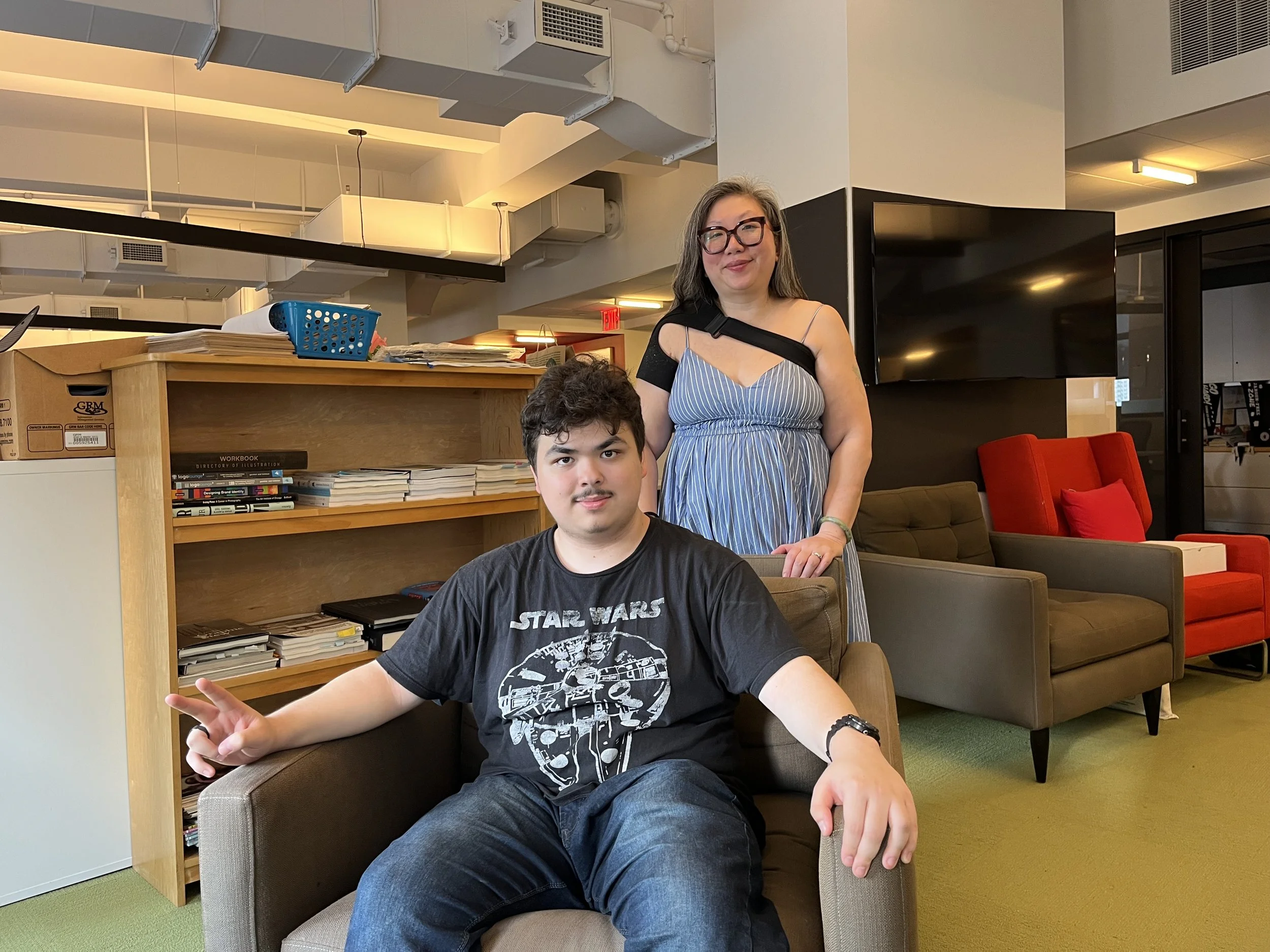
Lucas Healy, left, and his mother, Paulette Ha-Healy, discuss their experience navigating a school bus system plagued by constant delays and no-shows. Photo by Mira Gordon
Constant delays. No-shows. Missed class.
Roughly 145,000 New York City students, 43% of whom have disabilities, rely on yellow bus service to get to school each day. It’s a sprawling system with 9,000 routes operated by more than 50 different companies at a cost of more than $2 billion a year.
But sometimes, the buses don’t arrive at all. Parents are often unable to track buses or contact busing companies, forcing many families to pay out of pocket for cabs or keep their kids home from school.
P.S. Weekly producers Noa Salas Adam, a junior at Stuyvesant High School, and Katelyn Melville, a rising sophomore at City College, explore the challenges faced by students with disabilities who rely on busing, including academic setbacks, missed time with friends, and lack of access to OMNY cards to commute to jobs or after-school programs.
Lucas Healy, a senior with autism at Brooklyn’s High School of Telecommunication Arts & Technology, opens up about missing class because of unreliable busing and the emotional toll it’s taken, which still affects him today. His mother, Paullette Ha-Healy, shares her experiences navigating limited options when the bus didn’t arrive, and her frustrations with the Office of Pupil Transportation overseeing the Education Department’s massive transportation system.
“I didn't like it when I was left out,” Lucas said of missing class because of busing. “And because of that, I felt lonely because I wasn't there, and it's definitely not fair.”
The Education Department has said some fixes are on the horizon: The city is promising upgraded software by September that will create shorter and more efficient routes. Officials pledged to release bus vendor “scorecards” in June, rating bus companies on various metrics, including driver safety and bus breakdowns.
P.S. Weekly is a collaboration between Chalkbeat and The Bell. It’s available on major podcast platforms, including Apple Podcasts and Spotify. Reach us at PSWeekly@chalkbeat.org. New episodes drop on Thursdays.
P.S. Weekly is made possible by generous support from The Pinkerton Foundation.
Noa: It's five AM and you're waiting in the street. It's cold, it's dark, and you're growing impatient. Impatient because the yellow school bus just isn't coming. Maybe the bus will come in forty-five minutes or an hour or two, but there's no way to know. There's a number to call, but you know it will ring forever.
MUSIC
This is PS Weekly, the sound of the New York City school system. I'm Noah Salas Adam, a junior at Stuyvesant High School.
Katelyn: And I'm Katelyn Melville, a recent alum of the Brooklyn Institute for Liberal Arts and finishing up my first year at City College. But back to you, Noa. Waiting for a school bus at 5:00 AM?
Noa: Though not always this early, thousands of New York City public school students rely on school buses to get to class each day, 145,000 to be exact, and these buses are unreliable. That means they don't show up on time, take inconvenient routes, and sometimes don't even come at all.
In just the first weeks of the 2025 to 2026 school year, there were 4,476 no-shows and 8,068 reported bus delays and breakdowns.
Katelyn: Wow, I guess I didn't realize just how many students in the city take school buses. I'd always assumed the majority just took public transportation, but now it's really worrying that kids are relying on buses that are so unpredictable.
Noa: That's right, and in most cases, they actually don't have many options. According to Chalkbeat, 43% of students who take the bus have disabilities. Many of these students have individualized education programs, or IEPs, that are meant to guarantee them busing to get to schools that meet their needs.
Katelyn: This must be a major headache for a lot of families
Noa: Absolutely. Parents lose work because of their children’s busing problems. I also learned that students who are eligible for busing don’t get OMNY cards, which raised equity concerns for me. The same students who might be eligible for busing in their younger years might be ready to travel independently later. Having an OMNY card opens up the chance to get to a job or participate in afterschool programs.
Katelyn: Yeah and those 3$ fares really add up! This makes me wanna hear a perspective from a student who had to go through it.
Noa: Me too. I spoke to Lucas Healy, a senior in high school with autism, and his mom, Paullette Ha-Healy. Lucas is a student attending the High School of Telecommunication, Arts, and Technology in a District 75 program.
Katelyn: Where is District 75?
Noa: District 75 isn't a geographical district like District 2, where I go to school. Instead, it has programs in schools all over the city for students who need highly specialized instruction. And because D75 isn't a physical district, students with disabilities often have to go to school outside of their neighborhoods to get their needs met. this is where the school buses come in
Katelyn: So there's a whole school district to accommodate students with disabilities, and there are still busing issues going on in these schools? I mean, like, forgive me if I sound shocked, but how do you expect to give a student specialized instruction if you can't even get them there in the first place?
Noa: Exactly, and missing days of this instruction adds up, and it really impacts these students' education. .
But that's enough from us. Lucas and Paullette had to live it.
MUSIC
Noa: Lucas, we'll start with you. Um, could you just say your name, how old you are, and what school you go to?
Lucas: Yeah. Well- I'm Lucas Healy, and I'm a D75 student. I went to, High School of Telecommunications, but this year I'm graduating to Kingsborough Community College.
Noa: Congratulations. And Paullette, could you share your name, your occupation, anything, like, relating to your advocacy or anything else that you'd like to share?
Paullette: Sure My name is Paullette Ha-Healy. Uh, I'm a disability advocate. I'm actually a, coordinator for the borough of Brooklyn for the Civic Engagement Commission, so I, I'm a civil servant.
but my lifelong, um, love and purpose in life is to advocate for the disability community. Uh, I'm a woman with a disability myself, and I'm raising two children in the public school system who have learning disabilities as well, and that's what brought me here to you.
Noa: What inspired your advocacy in a larger sense?
Paullette: Well, when I became a mother for the first time and, I didn't really have any peers or siblings to tell me, like, what raising a child would be like, and I was so extremely happy when Lucas came into my life, that I wasn't aware that there was anything different about him.
And when we went for his pediatric milestone, appointments, uh, our pediatrician told us he wasn't hitting certain milestones and suggested we have him assessed, and that's when we discovered that he was on the autistic spectrum. And, knowing that he was different, and realizing that the public school system is not really geared for children who are neurodiverse as he is, that I was gonna have, uh, quite the fight in front of me.
Noa: So I know from speaking to both of you earlier that Lucas, you took, um, a bus to your early intervention program when you were around, is it three?
Lucas: That's correct.
Paullette: So Paullette, what's an early intervention program?
So an early intervention program is a, um, a program that is available for people with disabilities as early as birth to help provide supportive services depending on what their challenges happen to be. So, um, we were eligible for the services. Unfortunately, where we were living at the time, which was Windsor Terrace in Brooklyn, um, there was no, spots available in the early intervention, programs within our neighborhood.
So we were able to get accepted into a program in Bushwick, and that entailed a three-hour bus ride, uh, back and forth every day. So at three years old, Lucas was up at 5:00 in the morning, was on a bus at 5:15 every morning, and then arrived at his early intervention program, um, in Bushwick at 8:00 AM, and then would leave the program at 3:00 PM and arrive home at 6:00 PM, at the end of the day, which is a, an incredibly long day for a three-year-old.
Lucas: I didn’t mention to you that there were sometimes the bus never came
Paullette: Yeah, there were unfortunately some times where the bus didn't show up, and we would be sitting outside in the dark at 5:00 AM waiting for the bus to show up, and there was no communication.
We would try calling the bus company, but unfortunately no one would pick up. Um, and we would call the school, and of course, there's nobody there. And it, it really left very little recourse for families who were dependent on this particular service.
The first year was rough. It was a, it was a major adjustment. Um, Lucas presented with a lot of behavioral, challenges, as rightfully so, considering he was sleep-deprived, and, you know, a child, you know, at that age is supposed to have more, nap times and play times and, you know, things of that nature.
And, that just wasn't afforded to him because he spent six hours every day, five days a week just traveling to this program.
Noa: Did things get better after early intervention?
Paulette: Elementary school was pretty much, like, the most chaotic and inconsistent time when it came to school busing for Lucas.
Um, during, the kindergarten year when he started,, all of the bus drivers actually went on strike because of the contract negotiations that were happening with the mayor. And, um, because of that strike, we were not able to get Lucas to school for almost three months
until the strike was over. And, when you're in kindergarten and you're learning, like, fundamental, skills in terms of, like, language and behavior and comprehension- Three months is a lifetime for a kindergartner, and again, we weren't able to really make up those services.
and then when, um, there wasn't a strike, , we would still experience a lot of inconsistent disruptions in service. And when he was in third grade, he missed 56 days of school due to the bus not showing up. There was one time a bus showed up at noon at our house to pick him up, and at that point, I had already taken a cab to get him to school.
Katelyn: And not everyone has access to other options.
Noa: Yeah, it's a privilege to be able to drive to school or pay for a car if the bus doesn't come, and also to be able to advocate for your child in these situations.
The unpredictability of Lucas's bus caused Paullette to quit her job.
Paullette: There was so much disruption, and I lost a lot of days of work, and my job was just like, “we need someone who's, dependable." and as, as hardworking as I was, I could not promise them that th- that school bus was gonna show up the next day. And this is a citywide,travesty because there's, thousands of families that are affected when their school bus doesn't arrive, and tons of families who end up losing employment, because of disruptions and, putting out thousands of dollars for cab fares and bus fares and, you know, alternate transportation options, um, when- The DOE is paying millions of dollars to these bus contractors to provide us this service. And Lucas, thankfully was able to bounce back from all of those absences. And, traditionally, you know, you have 20 absences, you're already like And then Lucas himself as a child, like, he loved school. He, he made friends there. So, like, on those days when the bus didn't show up, he was angry. you know- Yeah ... and-
Lucas: I, like, I felt kinda, like, left out because of stupid busing.
Noa: Yeah. Lucas, could you tell me about that feeling of being left out when your friends are at school, but you couldn't be there because of the unreliable busing?
Lucas: Mm-hmm Well, let's just say I just, I didn't like it when I was left out. And because of that, I felt, well, lonely because I wasn't there, and it's, it's definitely not fair. It's literally, like, not fair to be left out. I mean, what the heck?
Paullette: It still hurts you now. Mm-hmm. You're, you're 18. Yeah. And it was 10 years ago. So it's like these are, these are the kind of scars that nobody sees on the outside, and, you know, sometimes I don't even realize, like,, how raw it still is for him, you know, until I hear the anger in his voice just like I did just now and- Hearing him say, "I felt lonely," like, no mom ever wants to hear that, you know, from their kid, and not being able to fix it, so...
Lucas: Yeah, that's what's going on with my life with busing, busing problems and stuff. I just really wish I was there, back then.
Paullette: Yeah, and I know, I know that also makes you more empathetic to your friends, too.
Like, when, when you're, you, you come home and you tell me that,one of your other friends, wasn't able to get to school 'cause the bus didn't show up. Like, I know that you know how that feels, and you worry about them, and you worry about how they're feeling.
And yeah it hurts, no matter how old you are. Whether you're in third grade, in middle school, in high school, it, it just sucks not being able to, to be part of, you know, everything that's going on, especially, like, this being your last year of school, too.
Lucas: Yeah. Well, I won't let that repeat the same way when I graduate, like, at community college. I just won't repeat the same way from, like, 10 years ago.
Paullette: Yeah. I think you've got more skills now to cope than you did back then.
Lucas: Yeah.
Noa: Lucas, you mentioned that you now travel independently. I was wondering when that decision was made and what it's like now, your commute.
Lucas: I've learned how to travel independently, well, the day the pandemic, well, passed out. My mom taught me how to, like, travel independently and how, how long will it take to get there.
Paullette: Yeah, I, I will say, like, you know, in addition to that, the pandemic really was, like, a game changer for a lot of us, you know, for all different kinds of reasons.
But, as the schools were pivoting to remote learning and District 75 was trying to figure out how to support students that were neurodiverse with multiple, , cognitive challenges, with remote learning, Lucas was one of the few that thrived, um, during COVID. ... He jumped up three reading levels,, you know, utilizing the assistive technology that was available, in order to comprehend the, the content that they were giving him.Um, but, uh, but he was definitely, , one of the students that, like, given the right tools, you know, in that, remote environment, he, he jumped forward. He was, he progressed.
And, um, thankfully we were able to get him into a program that was relatively close to the house. It still re- requires some public transportation, but, um, he felt confident that he didn't need the school bus anymore. So, um, once, some of the restrictions during COVID were lifted and we were able to use the trains and the buses, you know, more frequently
we spent the entire summer, um, travel training. And, um, D75 actually has a incredible travel training program that they utilize for their students. However, during the pandemic, there was a lot of, um, staffing turnover and the demand for that program was incredibly immense, so, there was a ton of students that were wait-listed for the travel training program.
And again, you know, time waits for no one, so we took it upon ourselves to, um, to train Lucas. Um, and not just about, like, you know, how to get on the train, what stop to get off, but also, like, you know, what happens if a train station is closed? What happens if a bus route gets rerouted? Uh, what happens if you get stranded because of, uh, climate, you know, um, uh, challenges and things of that nature?
What tools do you use in order to get home?
Paullette: You know, if you're lost, you, you need to have a Lucas in your life. he's, you know, he's helped other students. You know, like, when he sees them, um, struggling, uh, trying to, like, figure out where they're going, he's always trying to lend a hand. So I think that it was, um, it was a huge, huge, uh, turning point when it came to, Lucas just being able to immerse himself into, like, his school environment. He had the freedom of being able to get home by himself if he wanted to go to an after-school program or, uh, audition for the school play and, or, participate in a talent show or, or, you know, take advantage of the tutoring services that were available at the school. He wouldn't have been able to do that if he was still strapped to, um, a bus.
Noa: I wanted to ask, about, like, the Omni cards because I know that when you're taking a school bus, you don't have access to an Omni card, right? So you have to, like, rush or you're not able to participate in after-school activities.
Paulette: I mean, the whole reason, you know, um, a lot of, um, travel advocates and students, advocated at the DOE to provide OMNY cards to all high school students was because our high school students have other obligations outside of school. They have jobs, they have after-school programming, some are going to night school, you know, to make up for credits that they can't, um, do because their attendance just isn't where it should be and, you know, there are students who are overage and under-credited who really, you know, need to be able to have some flexibility with their education.
Um, it just expands the world for them. It allows them to participate in after-school programming, it allows them more freedom, um, to be able to travel more independently. Um, and, you know, for, for some families it's a, you know, transportation's a hardship. You know, paying that $3, you know, for that train ride, it, it taps into whatever money they're bringing home for food and rent. And if there's some way that we can lighten that load because the DOE happens to have a cadre of these OMNY cards, um, we should extend it.
Noa: Did you feel also left behind academically, or how, how do you think that it impacted your school?
Lucas: Ugh, it made me feel like a failure, to be honest. I, most of the times when I tried to catch up on some stuff, but couldn't even figure out what the questions make sense, that made me felt like a failure, and it's just not fair for me. I just wish I wasn't feeling like that way, but I still am, every time.
Paullette: Yeah, it's, I mean, it's a testament to, like, how important it is, you know, um, to be present when you're at school. 'Cause especially when you get into, like, the, you know, the higher education, when it, middle school and high school, and there's so much emphasis on, on testing and, and assessments, you miss one day and that, you miss, like, an entire unit, you know? And, um, and then you're just playing catch-up the, the, the whole time.
Noa: I wanna talk a bit about the, Office of Pupil Transportation, and Brad Lander's audit- Mm-hmm ... um, from last year. I'm gonna read this to you. the 2023 to 2024 school year alone, OPT received more than 16,000 complaints related to special education transportation, over 15,000 calls about late pickups or late arrivals, more than 14,000 no-show pickup complaints, and more than 5,000 reports of disconnected calls. You mentioned that you've made calls, but could you tell me a bit more about that experience, and then we can get to your thoughts on OPT in general?
Paullette: Sure. Um, well, I mean, I've had experiences prior to the $9.5 million investment that they put into OPT to build out their call center, and even then there were still, what, 15,000 dropped calls? Yeah, I still... I, I would like to know what they spent their $9.5 [m]illion on, to be perfectly honest, because even when I talk to parents in schools now, they can't- they still can't get through to OPT.
Um, or they get the runaround where it's like they finally get someone, and they're like, "Oh, what's your school?" And they re-route them back to the school. Um, so that does not seem like a good use of, uh, funding f- to me at all. Uh, but, uh, prior to the $9.5 million investment into the call center, I would spend as long as two hours on hold trying to get through to a human being at OPT.
I had someone on the bus who was, like, talking to somebody and was like, "Yeah, the bus didn't show up again." And I literally, like, opened up my phone and gave them the number to OPT, and I said, "I will stay with you and see how long it takes for them to, like, pick up the phone with you."
And this was literally, like, what was it? Two months ago. And no joke, like, the reader on her phone, like, she hung up after 45 minutes When no one was picking up the phone.
Noa: Wow.
Paullette: 'Cause I, I don't know, like, you know, even where to look for this number, and I was like, "Well, save it. You're gonna need it." So um, yeah. I would say, I mean, if I had it my way, and I'm so grateful to have had, uh, the controller, um, push through this audit before he termed out because this was something that we were working on with the previous controller and we couldn't get it released, and we knew that we needed this kind of audit th- you know, and, and to build this momentum in order to make some change to, uh, the existing, you know, um, pupil transportation program.
Noa: Absolutely. Um, just to wrap up, Lucas, I wanted to ask you, if there's one thing that you could tell someone who doesn't understand how important this issue of fair busing is, what would you tell them?
Paullette: So if someone doesn't understand why busing is important, it's important because...
Lucas: Because of timing.
Paullette: Yeah, because that kid can never get that time back, right?
Yeah.
Lucas: Mm-hmm. Because that kid can never get that time back, and he could
probably going through a lot of challenges, like catching up with some work, making up with some friends, and trying to catch up on something you've felt left out. And I don't want that for them. Not ever. I don't want them to go through the same way I had many years ago.
Noa: Yeah. Thank you.Yeah. Thank you so much for coming and for talking with me today. I'm really excited, um, for the episode and to share it with you both.
Paullette: Thank, thank you so much for the opportunity- Yeah ... to really bring more awareness around this.
MUSIC
Noa: Chalkbeat reported on the city’s recent promises to improve the bus system, including new routing software coming in September to bring shorter and more efficient routes.
In response to Chalkbeat’s questions about the changes, an Education Department spokesperson said, “Over the years, we have made significant progress, and enhancing our students’ transportation experience remains one of our top priorities.” She added: “New York City Public Schools continues to evaluate and improve our bus operations for families, ensuring our services remain reliable.”
Noa: In three years, contracts between the city and busing companies will be up. Either the same system of constant delays and lack of communication will continue–
Katelyn: Or we'll reach something better. I’m curious, what happens next?
Noa: Well, Paullette did tell me about some possible solutions she and other advocates are exploring. She spoke about the expansion of the NYC School Bus Umbrella Services or NICE BUS , a non-profit that currently manages about 800 routes. It has also started working with electric buses, Including working GPS systems would also help hold bus companies accountable and give parents real-time updates on their kids’ commutes. All of these solutions envision a system where the city has more control over bus routes and timing – so students with disabilities can get to their programs on time every day.
Katelyn: And every day really matters. Hearing Lucas talk about his own experiences really shows how impactful missing school because of busing delays is.
Noa: Lucas has grown up a lot since he was that little boy on the bus. He travels independently now. He loves to cook, and he's headed to community college in the fall. But you can hear in his voice that he's still really upset about how the system failed him so many years ago. He missed his friends and felt like a failure in school.
He's angry that other kids will have to go through what he went through.
Katelyn: That feeling of being left out or forgotten is something so many people can relate to.
Noa: It also makes me think of how involved Paullette is. She's become an expert in busing, and was able to really fight for Lucas and so many other students with disabilities across the city. But what about all the kids without that support? It's hard even under the best circumstances
Katelyn: That's all for today on PS Weekly.
Noa: PS Weekly is a collaboration between The Bell and Chalkbeat, made possible by generous support from the Pinkerton Foundation.
Producers for this episode were me, Noa Salas Adam-
Katelyn: And me, Katelyn Melville.
Noa: our senior producer for the show is Maria Robins-Somerville, and our technical director is Jake Loomis.
Katelyn: Our executive editors are Amy Zimmer and Taylor McGraw.
Noa: Additional production and reporting support was provided by Mira Gordon, Sabrina Duquesnay, Zana Halili, and our friends at Chalkbeat.
Katelyn: Music is from APM, and the jingle you heard at the beginning of the episode was created by the one and only Erica Huang.